What Is the Best 3D Printer Filament in 2026?
Choosing the best 3D printer Filament in 2026 depends less on a single “winner” and more on what you plan to print. A lightweight PLA spool may suit a detailed desk model, while PETG can make more sense for a bracket exposed to moisture. Flexible TPU behaves differently again. There is no magic material.
This guide compares common filament types by printability, strength, heat resistance, surface finish, cost, and storage needs. It also considers practical details: a damp spool can hiss and leave rough surfaces, while poor bed adhesion may curl the corners of a broad print. Printer compatibility matters, too. Check the recommended nozzle temperature, build-plate limits, and whether an enclosure is needed before buying. Small details count.
Material labels can be imperfect guides. Two brands’ PLA may print differently, and manufacturer specifications are not always directly comparable. That makes any ranking provisional, not universal. The right choice also depends on the part’s shape, expected loads, and operating environment—not just a headline strength figure. Nylon, ABS, and ASA may offer useful properties, but they can demand more careful temperature control and ventilation. For beginners, dependable results may matter more than a material’s maximum performance. For experienced users, tuning and drying can change the outcome. This overview aims to help you narrow the options, understand the trade-offs, and choose a spool suited to your printer and project. It cannot replace a small test print.
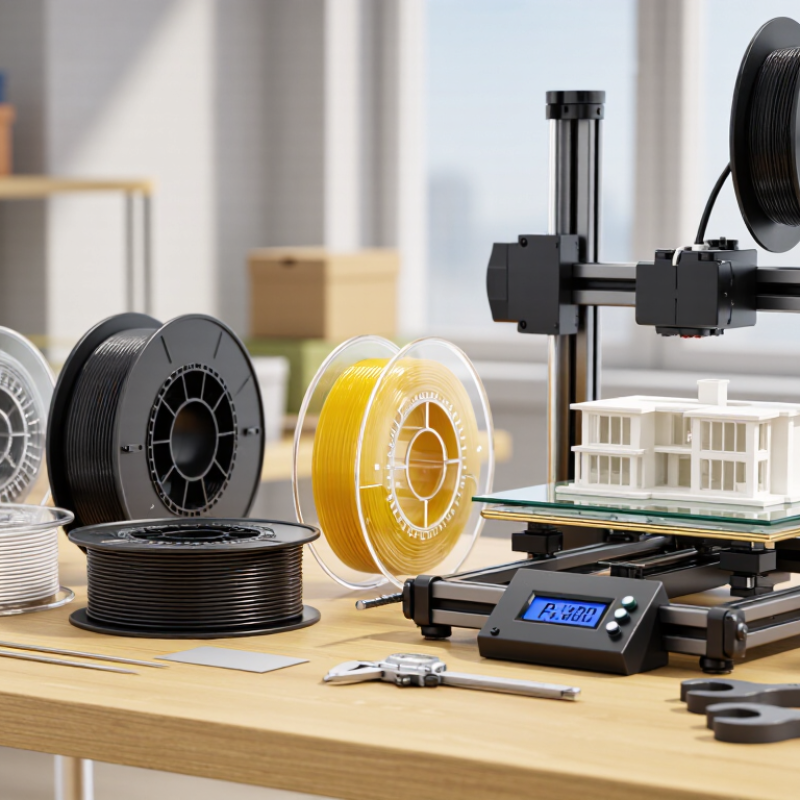
How 3D Printer Filament Is Classified: 1.75 mm Is the Common Diameter
Filament diameter is one of the simplest ways to classify 3D printer filament. The most common size for desktop machines is 1.75 mm. Some printers use 2.85 mm filament, often casually called 3 mm. These sizes are not interchangeable without compatible feed hardware.
Check the printer’s specifications before buying a spool. The extruder gears and filament path must match the diameter; the nozzle opening is a separate measurement. Small difference. It matters. Consistent diameter also helps the extruder feed material steadily. If the filament varies too much, you may see uneven lines, gaps, or excess material on a print.
Look for the stated diameter and tolerance on the spool label, though the label alone cannot guarantee perfect consistency. Keep filament dry, too: moisture can cause popping sounds and rough surfaces, which may be mistaken for a diameter problem.
Diameter does not tell you whether the material is PLA, PETG, or another type. I’d check both compatibility and material needs, even when a spool seems like an easy fit.
Compare PLA, PETG, and ABS: Typical Densities Range from 1.04 to 1.27 g/cm³
What Is the Best 3D Printer Filament in 2026?
Filament density helps estimate how much material a print uses, but it does not decide which plastic is best. PLA typically measures about 1.24 g/cm³, PETG about 1.27 g/cm³, and ABS roughly 1.04–1.07 g/cm³. Exact values vary with formulation and additives. For equal-volume parts, PETG may weigh slightly more than PLA, while ABS may weigh less. The difference can matter for a lightweight bracket or a model with many solid sections. It matters less for a small, mostly hollow decoration.
Density is only one part of the choice. PLA is often convenient for detailed indoor prints; PETG can suit parts that need more toughness and moisture resistance. ABS handles higher temperatures than PLA, but can warp during printing and may need a controlled setup. Check the filament’s technical data sheet when weight estimates matter. Then compare a small test print with your actual wall count and infill. A density table is a starting point, not a winner chart. I would not trust a single number to predict a finished part’s performance.
Tips: Use your slicer’s material density setting to estimate filament use. Keep the same model, infill, and wall count when comparing materials. Small differences can be hard to notice, and printer settings can change the result.
Match Material to Printer Settings: PLA Commonly Prints at 190–220°C
What Is the Best 3D Printer Filament in 2026?
Match Material to Printer Settings: PLA Commonly Prints at 190–220°C
PLA is a practical starting point for many everyday prints, but its temperature range is not a fixed recipe. A nozzle setting between 190°C and 220°C often works. Check the spool’s guidance, then adjust in small steps. A calibration tower can show whether details stay clean across temperatures.
Too cool, and thin walls may look weak or layers may separate. Too hot, and corners can soften, strings may trail between parts, or small text can blur. Start near the middle of the range, around 205°C, if the filament gives no clearer recommendation. Watch the first few layers. They tell you a lot.
Temperature is only one part of the setup. Bed temperature, cooling, print speed, nozzle condition, and room drafts also affect results. Keep the bed level and use moderate cooling after the first layers, following the filament maker’s guidance. If extrusion looks uneven, check for a partial clog before raising the heat. I have to remind myself of that. More heat does not fix every problem.
Use the same test model when comparing settings, and change only one variable at a time. Record the nozzle temperature beside the spool, because two PLA blends can behave differently. A 5°C adjustment may improve a bridge yet make a sharp edge look worse. Small changes matter. That trade-off is real.
What Is the Best 3D Printer Filament in 2026? — Match Material to Printer Settings
| Filament | Typical Nozzle Temperature | Typical Bed Temperature | Enclosure | Best Suited For | Key Considerations |
| PLA | 190–220°C | 0–60°C | Not usually required | Beginners, prototypes, display models, and general-purpose prints | Easy to print and low-warping; less suitable for sustained high heat or demanding outdoor use. |
| PETG | 220–250°C | 70–90°C | Usually not required | Functional parts needing more toughness and moisture resistance than typical PLA prints | Can string; moderate cooling and a clean, compatible build surface can help. Confirm surface compatibility before printing. |
| ABS | 230–260°C | 90–110°C | Recommended | Durable parts and applications that may benefit from post-processing | Prone to warping and shrinkage; printing can release fumes, so use suitable ventilation. |
| ASA | 240–260°C | 90–110°C | Recommended | Outdoor parts requiring better weather and UV resistance than many common plastics | Can warp; use suitable ventilation and follow the filament maker’s handling guidance. |
| TPU | 210–240°C | 30–60°C | Not usually required | Flexible parts such as grips, bumpers, seals, and protective covers | Print slowly; flexible grades are generally easier to feed through a direct-drive extruder. |
| Nylon (PA) | 240–280°C | 70–100°C | Recommended | Tough functional parts subject to wear or repeated mechanical stress | Absorbs moisture readily; dry the filament as directed and keep it dry during printing. |
| Polycarbonate (PC) | 260–310°C | 90–120°C | Strongly recommended | Rigid, heat-resistant parts when the printer can sustain the required temperatures | Requires a high-temperature-capable hot end and build surface; drying is often important. |
Temperature ranges are common starting points, not universal specifications. Check the filament’s packaging and adjust for its formulation, printer, nozzle, and build surface.
Compare Strength Using ASTM D638 Datasheets: PLA Often Reaches 50–70 MPa
PLA is often reported at 50–70 MPa in tensile-strength datasheets, making it a strong candidate for everyday prints. But that range is not a guarantee for a finished part. ASTM D638 measures tensile properties under specified test conditions; results can change with specimen geometry, conditioning, and testing speed. Some datasheets test molded samples, while a printed component contains bonded layers and may fail between them. A neat number can hide that difference.
Tips: Compare only values tested under similar conditions. Check whether the sample was molded or printed, and note the print direction. For a bracket, load direction matters.
For practical selection, look beyond peak strength. A thin clip may need flexibility, while a wall-mounted hook may need resistance to steady pulling. Print a small test piece with the same nozzle, layer height, and orientation as the real part. Then inspect where it bends or breaks. It is a little tedious, and one test is not a universal answer. Still, it can reveal more than a datasheet value alone. Keep the datasheet and test notes together; otherwise, comparisons become guesswork.
What Is the Best 3D Printer Filament in 2026?
ASTM D638 tensile-strength ranges reported in filament technical data sheets (MPa)
PLA commonly reaches about 50–70 MPa, making it a strong choice when tensile strength is the priority. The bars show approximate reported ranges, not a controlled head-to-head test; results vary with filament formulation, specimen preparation, print settings, and test conditions.
Choose the Best 2026 Filament by Application, Printability, Cost, and Safety
The best 3D printer filament in 2026 depends on the part, not the trend. Wohlers Report 2024 valued the global additive manufacturing industry at $20.035 billion in 2023, an 11.1% increase from 2022. That growth does not make one material right for every job. PLA is often practical for indoor prototypes and decorative parts because it prints easily. For functional parts exposed to moisture, PETG can be a sensible choice. Nylon can handle demanding mechanical use, but it absorbs moisture and needs dry storage. Flexible TPU works for grips and bumpers, though slower printing may test your patience.
Compare the cost of a usable part, not just the price per spool. A cheaper filament can waste time through failed prints, drying, or extra setup. Not always obvious. NIOSH safety guidance notes that 3D printing can release ultrafine particles and volatile compounds; emissions vary with material and printing conditions. Use suitable ventilation, follow the printer and filament instructions, and avoid running printers in poorly ventilated rooms. ABS and other higher-temperature materials may need more careful ventilation and temperature control. Check the required strength, flexibility, finish, and operating environment before choosing. Then test a small part. I still find that one short test print can reveal more than a tidy spec sheet.