


What Are the Best Steel Parking Bollards in 2026?
Choosing the best Steel Parking Bollards in 2026 means matching protection to the site, not choosing the thickest post. A busy retail entrance, a school drop-off lane, and a private garage face different risks. Steel grade, wall thickness, spacing, foundation depth, finish, and maintenance all matter. Details matter.
The World Health Organization’s Global Status Report on Road Safety 2023 estimates 1.19 million annual road deaths worldwide. NHTSA’s 2023 traffic-safety reporting recorded 40,901 U.S. traffic fatalities. These figures describe a wider safety environment; they do not prove that bollards prevent crashes. For impact-rated products, ASTM F2656/F2656M provides a vehicle-crash test method. Buyers should check the tested rating and installation conditions, not rely on a product label alone. Security technologist Bruce Schneier’s familiar observation, “Security is a process, not a product,” is a useful reminder: hardware works as part of a broader site plan.
This guide compares fixed, removable, and retractable Steel Parking Bollards by protection level, installation demands, visibility, and upkeep. A polished sleeve can look reassuring while concealing weak anchoring. That is easy to miss. One limitation deserves attention: crash-test results cannot represent every parking-lot layout, soil condition, or vehicle approach. Use the evidence as a starting point, then verify site requirements with a qualified installer or security professional.
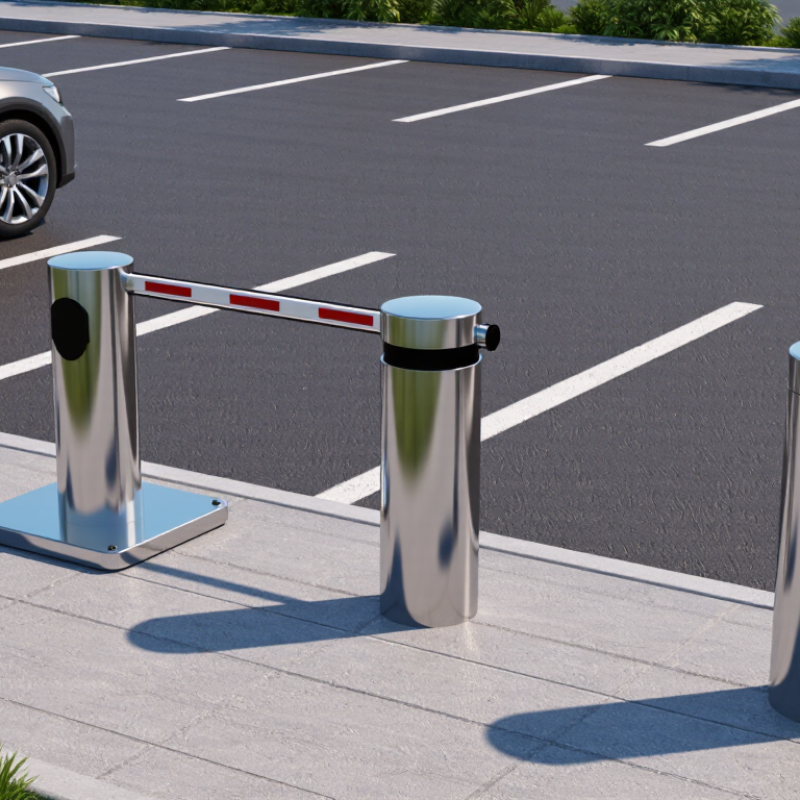
What Steel Parking Bollards Do and Where They Are Used in 2026
Steel parking bollards are fixed or removable posts that help define vehicle boundaries and protect people, walls, doors, and equipment. Their steel construction offers a sturdy barrier, but performance depends on post diameter, wall thickness, anchoring, and site conditions. A bollard is not automatically impact-rated because it is made of steel. Check its specifications and installation details before relying on it for a particular level of protection.
In 2026, these posts appear in parking lots, garage entrances, loading areas, storefront edges, and pedestrian routes. At a busy shop, a row near the entrance can discourage accidental bumper contact while keeping a clear walking path. In garages, bollards can shield payment machines, columns, and electrical cabinets. Removable models suit service access points, though staff need a clear procedure for handling them. Small details matter.
Spacing and visibility deserve careful planning. Posts placed too close together may obstruct strollers or maintenance carts; posts set too far apart may not guide vehicles as intended. Reflective bands help drivers notice bollards in dim garages, while contrasting paint can make them easier to see in daylight. Drainage, corrosion exposure, and base condition also affect long-term reliability. These are easy to overlook. Even a well-chosen post can become a trip hazard or loose fixture if its placement and upkeep are treated as afterthoughts.
What Are the Best Steel Parking Bollards in 2026? What They Do and Where They Are Used
There is no single best steel parking bollard for every site. The right choice depends on the required level of access control, impact protection, installation conditions, visibility, and maintenance needs.
| Bollard Type | Typical Construction and Size | What It Does | Common Locations | Key Selection Considerations |
|---|---|---|---|---|
| Fixed steel bollard | Steel pipe or formed-steel post; commonly around 4–6 in. (100–150 mm) in diameter and 30–48 in. (760–1,220 mm) above ground. Actual dimensions vary by design. | Creates a permanent barrier to discourage vehicle entry and protect defined areas. Protection against vehicle impact depends on the complete installation, not steel construction alone. | Parking-lot edges, storefronts, building entrances, pedestrian paths, loading-area boundaries, and equipment enclosures. | Check foundation depth, underground utilities, vehicle approach paths, required clearances, and whether the post has been tested for a stated impact rating. |
| Removable steel bollard | Steel post secured in a ground socket or receiver; commonly available in diameters similar to fixed posts. The post can be lifted out when access is needed. | Provides a barrier that can be temporarily removed for authorized vehicle access. | Service entrances, shared-use paths, event spaces, emergency access routes, and restricted parking areas. | Confirm the locking method, socket drainage, storage arrangements, and how the opening will be secured when the post is removed. |
| Retractable steel bollard | Steel post that lowers into a below-ground housing; manual and powered systems are available. Housing dimensions and excavation requirements depend on the model. | Allows controlled vehicle access while keeping the bollard in place when raised. | Controlled driveways, commercial entrances, campuses, and sites with frequent authorized vehicle movements. | Plan for drainage, power supply where applicable, maintenance access, operating controls, and safe clearance for the moving post. |
| Surface-mounted steel bollard | Steel post attached to an existing concrete slab using a base plate and anchors; commonly used where below-ground excavation is limited. | Defines boundaries and helps deter casual vehicle encroachment without a deep in-ground socket. | Parking garages, loading areas, walkways, and retrofit projects with suitable existing concrete. | Verify slab thickness and condition, anchor specifications, edge distances, and the intended impact level. Surface mounting does not automatically provide crash-rated protection. |
| Decorative or protective steel bollard | Steel post with a painted, coated, stainless, or sleeve finish; optional covers can improve visibility or match the surrounding setting. | Separates vehicles from people, buildings, landscaping, or utilities while contributing to site appearance. | Retail frontages, offices, public plazas, pedestrian zones, and landscape borders. | Choose a finish suited to weather and maintenance conditions. Use contrasting colors or reflective bands where visibility is important. |
| Crash-rated security bollard | Engineered steel post-and-foundation assembly designed and tested as a system to a specified vehicle-impact standard. | Provides a documented level of vehicle-impact resistance when correctly installed in the tested configuration. | High-security perimeters, critical infrastructure, sensitive entrances, and locations identified by a security assessment. | Review the exact test standard, vehicle mass and speed, penetration distance, foundation design, spacing, and site-specific installation requirements. |
| Parking-space or wheel-stop bollard | Steel post or low-profile barrier positioned near a parking space; dimensions and mounting method vary with the intended use. | Helps protect walls, storefronts, pedestrian routes, or equipment from low-speed parking maneuvers. | End spaces, accessible-route edges, charging equipment, payment stations, and building-front parking. | Keep pedestrian routes and accessible spaces clear. Select placement and height to suit vehicle geometry and visibility; do not treat it as a substitute for a tested security barrier. |
2026 buying note: Compare complete system specifications, including post dimensions, steel grade, finish, foundation or anchoring details, tested performance where required, and maintenance provisions. Typical dimensions are indicative rather than universal; follow the manufacturer’s installation documents and applicable local codes.