
Choosing the best Turbo Intercooler for 2026 is not about finding the largest core or the flashiest product. It is about matching cooling capacity, pressure drop, fitment, and durability to the engine’s real demands. A street-driven car sitting in traffic faces different heat loads from a track car taking repeated hard laps. Get the match wrong, and a polished upgrade may deliver little.
Turbocharging expert Corky Bell’s system-focused approach in Maximum Boost offers a useful reminder: an intercooler works as part of the complete turbo system, not as an isolated horsepower upgrade. Put simply, cooler air matters. So does airflow. This introduction treats that balance as the starting point, rather than assuming one design suits every build.
The comparisons ahead will examine core construction, inlet and outlet sizing, end-tank design, installation space, and evidence of temperature control. We will also separate measurable performance from marketing claims. A lower intake temperature on one pull is not the whole story. Repeated runs, ambient heat, and pressure loss can change the result. Some recommendations will depend on your setup; that is less tidy than naming one universal winner, but more honest. Use the guide to narrow the options, then confirm fitment and test data for your vehicle before buying.
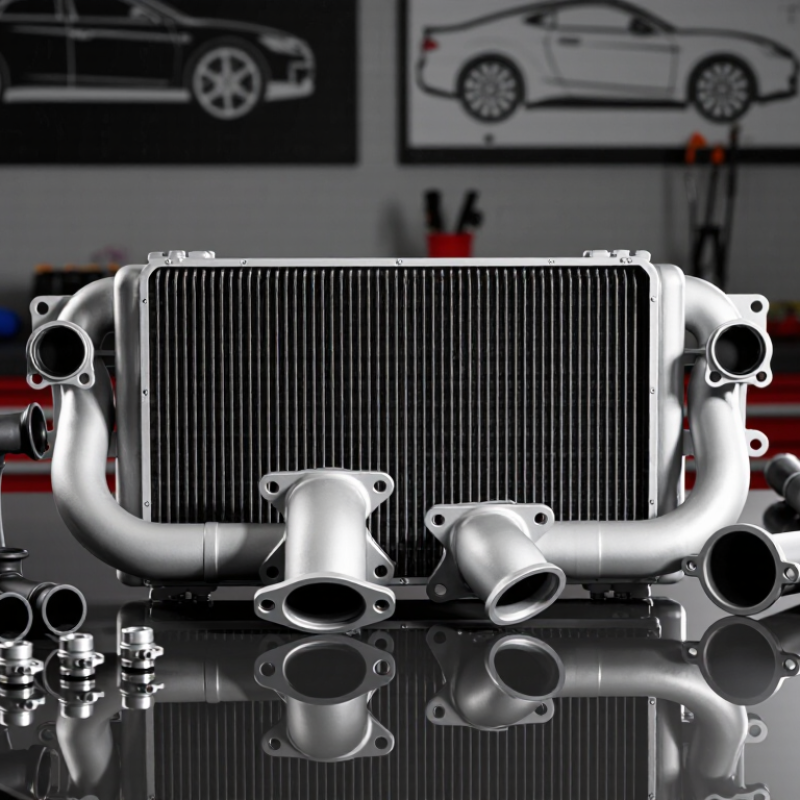
What Is the Best Turbo Intercooler for 2026?
What a Turbo Intercooler Does and How It Works
A turbocharger compresses intake air, helping an engine take in more oxygen. Compression also heats the air. Hotter air is less dense, which can reduce oxygen available for combustion and raise thermal stress. The intercooler sits between the turbocharger and engine, passing heat from compressed air to ambient air or coolant. That matters.
A simple ideal-gas calculation shows why cooling can help: at equal pressure, air cooled from 100°C to 40°C is about 19% denser. This is a theoretical comparison, not a guaranteed power gain. Real results depend on pressure, humidity, heat soak, airflow, and engine calibration. SAE International’s J1349 engine-power test procedure reflects the importance of controlled intake conditions when comparing engine output.
In practice, look for stable outlet temperatures under repeated acceleration, not just a large core or impressive peak figures. A core that cools well but creates excessive pressure drop can limit airflow. Small detail. Check temperature readings before and after the intercooler, and note ambient conditions during testing. I would not treat one short test as proof; heat builds slowly, and traffic can change the result. A slightly imperfect measurement is still useful if the method stays consistent.

A turbocharger heats air as it compresses it. An intercooler removes some of that heat before the air enters the engine. In this modeled example, ambient air is 25°C, compressor pressure ratio is 2.0, and compressor efficiency is 72%. Intercooler effectiveness describes how much of the temperature difference between the compressed air and ambient air is removed. These are calculated example values, not measurements for a specific vehicle or intercooler. The right choice also depends on fit, airflow, pressure drop, and durability.
A turbo intercooler should be judged by more than its size or advertised cooling claim. Its core must shed heat while keeping pressure loss modest, since excessive restriction can reduce airflow to the engine. That balance matters. Compare inlet and outlet temperatures after repeatable pulls, not a single quick run. Record ambient temperature, vehicle speed, and engine load; each can change the result.
Heat soak is another practical test. After several accelerations or a long climb, watch whether outlet temperatures rise sharply and recovery slows. A large core may perform well at speed but receive poor airflow in a cramped installation. Check ducting, fin condition, and clearance around the radiator and condenser. Installation details count.
Measure pressure drop with suitable sensors at comparable boost levels, and confirm readings more than once. Also consider core construction, corrosion resistance, service access, and whether hoses fit without sharp bends. A cooler reading alone does not prove better performance; fuel, ignition, and engine controls also influence results. There is no universal winner. Choose the intercooler that fits the vehicle’s power goal and driving pattern, then verify it under real conditions.
Air-to-air and air-to-water systems are the main intercooler designs, and each suits different packaging and driving demands. An air-to-air unit passes outside air through its core while compressed intake air travels inside. It is mechanically simple, needs no pump, and can work well when the vehicle has clear airflow through its front grille. But a thick core behind a blocked bumper may receive little cooling air.
Core construction also matters. Bar-and-plate cores are often robust and have substantial heat capacity, but their weight and pressure drop can be higher. Tube-and-fin cores tend to be lighter, though durability and cooling depend on the design and installation. Bigger is not automatically better. A core that is too restrictive can slow airflow to the engine, while poor ducting can leave parts of it barely useful.
Air-to-water systems circulate coolant between the intercooler and a separate heat exchanger. Their compact intake path can help in crowded engine bays, and stored coolant may soften brief heat spikes. The trade-off is added hardware: a pump, hoses, coolant, and another heat exchanger that must shed heat. In repeated hard acceleration, coolant temperature can climb. That detail is easy to overlook. Compare pressure drop, fitment, airflow, and the vehicle’s actual use before choosing; temperature readings under load are more informative than appearance alone.
How to Match an Intercooler to Your Vehicle and Driving Needs
The right intercooler depends on the vehicle, not just the power goal. Check the turbo setup, available space, pipe routing, and typical use. A commuter car facing stop-and-go traffic needs reliable low-speed airflow; a vehicle used for towing may need sustained heat control. Track use brings repeated high-load runs. Bigger is not automatically better. A large core can create fitment problems or add pressure drop.
Compare measured performance, not polished photos. SAE International’s J1723 charge-air-cooler test method evaluates heat rejection and pressure drop under defined conditions. Ask for test data showing airflow, inlet temperatures, and pressure loss; figures without test conditions are hard to compare. Lower outlet temperatures matter, but excessive pressure drop can make the turbo work harder to maintain boost. Small detail, big consequence.
Match the cooler to your real driving pattern and installation limits. Confirm clearance around the radiator, fans, and crash structure, then check whether the core receives clean airflow. There is no universal “best” size. Even careful estimates can miss heat soak in a crowded engine bay, so leave room to review temperatures after installation under repeatable conditions. The answer may be less glamorous than expected.
The best 2026 turbo intercooler is not automatically the largest. Match it to the vehicle and its use. Compare core dimensions, fin design, and internal flow path, then check pressure-drop and temperature data from similar test conditions. A cooler outlet charge matters, but airflow and boost response matter too. Numbers need context.
Fitment deserves equal attention. Check clearance near the radiator, bumper, and crash structure, along with hose routing and sensor locations. A core that forces a tight bend or rubs against a bracket can create problems later. Inspect the end tanks and welds, and confirm that mounting points align without stressing the pipes. Measure twice.
For a street car, balanced cooling, reliable fit, and manageable pressure loss may beat maximum core volume. A track-driven setup may need more heat capacity, especially during repeated hard pulls. Compare testing at similar ambient temperatures and boost levels; one short road run is weak evidence. I would also leave room for uncertainty: published results do not always match real traffic, and fitment can vary between model years. Check the exact vehicle configuration before buying.
There is no universally best intercooler: the right choice depends on the vehicle’s fitment, airflow, power level, driving conditions, and cooling-system layout. The comparisons below describe general design characteristics; actual performance varies with core design, installation, and operating conditions.
| Intercooler option | How it works | Main advantages | Trade-offs | Best fit | What to check before buying |
|---|---|---|---|---|---|
| Factory-style air-to-air | Compressed intake air passes through a core cooled by outside air. | Simple system; no separate coolant pump, reservoir, or heat exchanger is required. | Cooling depends on airflow and ambient conditions; heat soak can affect performance at low vehicle speed. | Stock or lightly modified vehicles used for everyday driving, when the original system is in good condition. | Vehicle-specific fit, unobstructed airflow, secure connections, and whether the existing core is damaged or restricted. |
| Upgraded air-to-air, bar-and-plate core | Air flows through passages formed by stacked plates and bars, with outside air passing over the core. | A robust construction can suit demanding use; larger cores may provide more heat-transfer area when airflow and packaging allow. | A larger or denser core can add weight or airflow restriction; size alone does not guarantee better cooling. | Modified road vehicles and builds that need an air-to-air system with increased cooling capacity. | Core dimensions, end-tank design, pressure drop, airflow to the radiator, mounting clearance, and tested fitment. |
| Upgraded air-to-air, tube-and-fin core | Intake air travels through tubes with fins that transfer heat to the passing outside air. | Can offer a relatively light core and good heat transfer when appropriately designed for the application. | Performance and durability depend on construction; a thin or poorly matched core may not meet the demands of a high-load setup. | Weight-conscious street or competition applications where the core is properly sized and supported. | Core construction, pressure rating, pressure drop, heat-transfer test data, and protection from vibration or impact. |
| Air-to-water system | Intake air is cooled by a liquid circuit; the warmed coolant then releases heat through a separate heat exchanger. | The charge cooler can be placed near the engine; the system can support compact pipe routing and controlled coolant flow. | Requires additional components such as a pump, coolant lines, and heat exchanger; adds complexity and needs proper maintenance. | Vehicles with limited front-mounted-core space or specialized packaging and competition requirements. | Pump capacity, heat-exchanger airflow, coolant volume, hose routing, electrical supply, bleeding, and service access. |
Practical comparison tip: Compare documented fitment, pressure drop, heat-transfer performance, pressure rating, and installation requirements—not just core size. A qualified installer can confirm compatibility with the vehicle and its intended use.
Copyright ©2024 Elephant Lifting Products | All rights reserved.
38381 N Robert Wilson Rd, Gonzales, LA 70737 USA
Toll Free: (888) 844-6113 | Phone: (225) 644-6113 | Fax: (225) 644-6695
Email: sale@floralift.org