
Buying Conveyors Equipment across borders is rarely a simple catalogue decision. A system that performs well in Germany may struggle in a humid warehouse in Southeast Asia. Material weight, belt speed, temperature, dust, voltage, and local maintenance skills can change the result. Every detail matters.
Dr. David J. Alspaugh, a respected conveyor design engineer, offers a useful principle: “Design around the material, not the catalogue.” This advice should guide every international purchase. Ask how the conveyor will handle sharp stone, sticky grain, fragile packages, or uneven loading. Request calculations for capacity, incline, motor power, belt tension, and emergency stopping. Do not accept attractive specifications without test data.
Supplier evaluation deserves equal attention. Check manufacturing experience, component brands, spare-parts availability, installation support, and documented safety procedures. Confirm whether drawings use metric or imperial measurements. Verify electrical standards before production begins. A small mismatch can delay commissioning for weeks.
The lowest quotation may hide expensive risks. Freight, customs, insurance, training, and replacement belts belong in the real budget. Warranty wording also needs careful review. Who pays when a pulley arrives damaged? Who responds when the system stops at midnight?
Even experienced buyers miss something. That is normal, but it should encourage reflection. A clear checklist reduces avoidable mistakes. Local site surveys reveal problems that photographs conceal, including uneven floors, restricted access, and unstable foundations. This guide explores ten practical tips for selecting Conveyors Equipment worldwide with stronger judgment, clearer questions, and fewer costly surprises.
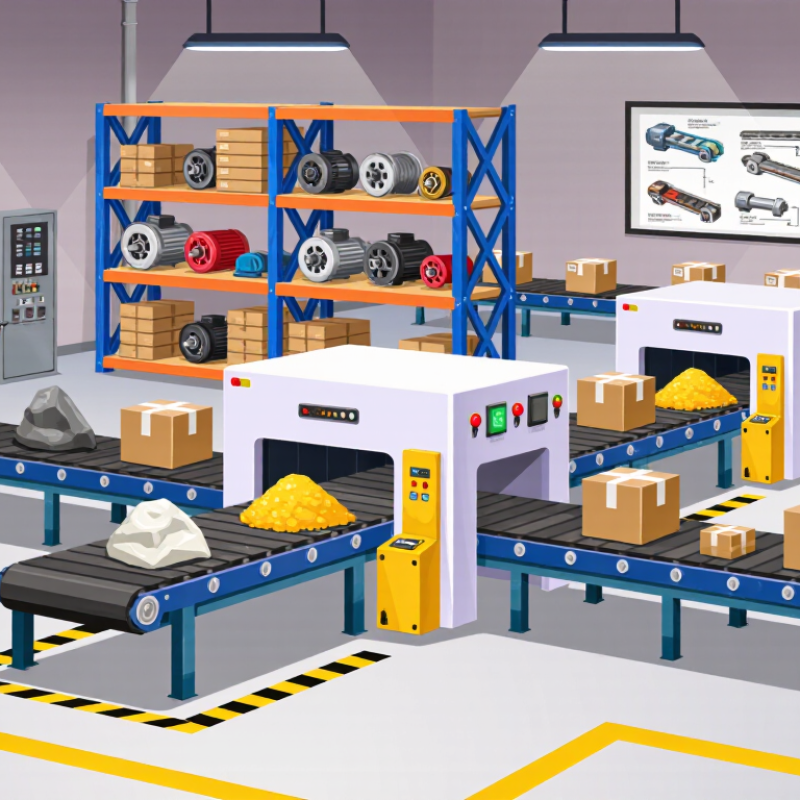
Before buying conveyors equipment worldwide, define the material with measurable details. Record bulk density, particle size, moisture, temperature, abrasiveness, and flow behavior. A powder may bridge inside a hopper, while damp granules can stick to belts. CEMA’s Belt Conveyors for Bulk Materials, 7th Edition, emphasizes material characteristics when selecting belt width, speed, and loading conditions. Do not rely on a supplier’s typical values. Test a real sample when possible.
Capacity must reflect the busiest operating hour, not the daily average. State tonnes per hour, feed consistency, operating hours, and acceptable surge volume. Include the conveying distance, elevation change, incline angle, transfer points, and discharge method. The required capacity should also match upstream and downstream equipment. Otherwise, the conveyor becomes an expensive waiting line. A 10% design margin may be sensible in one process, but careless in another. Check it against material behavior and motor loading.
MHI’s 2024 Annual Industry Report found that 55% of respondents planned to increase supply-chain technology investment. That investment deserves better input data. Specify washdown exposure, ambient temperature, electrical standards, guarding, noise limits, and maintenance access for each country. CEMA calculations can support preliminary sizing, but field validation remains valuable. In practice, a neat spreadsheet can still be wrong. Recheck the result after observing actual loading, especially when material changes seasonally. Request performance data at minimum, normal, and peak rates. Ask for test records, not confident promises.

Matching the conveyor to the product is more important than choosing the lowest price. Fragile cartons need controlled speed and gentle transfers. Abrasive minerals require wear-resistant surfaces and stronger frames. Sticky products may need wider spacing between rollers. Always check product weight, dimensions, temperature, moisture, and packaging stability.
Map the layout before requesting quotations. Measure straight runs, curves, transfer points, loading zones, and elevation changes. A small height error can create serious installation problems.
Match belt width and speed to actual throughput, not promotional capacity. MHI’s 2024 Annual Industry Report found that 55% of respondents planned to increase supply-chain technology investment. Automation is growing, but poor product matching still wastes that investment.
Operating conditions also control equipment selection. Dusty areas may require sealed bearings and protected drives. Washdown zones need corrosion-resistant materials and suitable guarding. Cold rooms can affect belt flexibility and lubricant performance.
Ask suppliers for test results using your real product.
Confirm electrical standards, documentation, spare parts, and service coverage for every destination country.
A conveyor can look excellent on paper. It may still fail at transfer points. The European Commission’s 2023 Energy Efficiency report also highlights the importance of reducing industrial energy use, so motor efficiency deserves attention. Yet energy savings should not reduce safe movement or product protection. A perfect specification is rare. Careful testing remains essential.
When buying conveyor equipment worldwide, supplier assessment should begin with evidence, not polished brochures. Ask for factory photographs, quality records, and recent project references. A video call can reveal whether production areas are organized and active. Request samples of welds, rollers, belts, and control cabinets. Small details matter.
Manufacturing expertise becomes clearer through technical questions. Can the supplier calculate load, speed, incline, and duty cycle? Can they explain material choices for dust, moisture, heat, or abrasive products? Experienced teams discuss failure points openly. They should provide drawings, tolerance data, inspection plans, and installation guidance. I would also ask who handles service after shipment. A low price can hide expensive downtime. My own checklist is imperfect; one supplier looked excellent until spare-part lead times were tested.
Customization should solve a measured problem, not decorate a standard machine. Confirm available widths, conveyor lengths, discharge heights, guarding, sensors, and control interfaces. Ask how modifications affect delivery, maintenance, and warranty terms. Require a written change-control process before approving designs. If your layout is unusual, request a factory acceptance test using comparable loads. Keep communication practical. Send photos, dimensions, product weights, and site constraints. Misunderstandings often begin with one missing measurement. Also verify packaging, documentation, commissioning support, and operator training. A capable manufacturer will question unclear requirements instead of accepting every request immediately.
| No. | Buying Tip | Key Evaluation Dimension | Practical Information to Verify | Useful Benchmark or Requirement | Warning Sign |
|---|---|---|---|---|---|
| 1 | Define the conveying application | Material characteristics and process conditions | Confirm material type, bulk density, particle size, moisture, temperature, abrasiveness, corrosiveness, and required conveying direction. | The supplier should size the conveyor from measured or documented operating data, not capacity alone. | A standard model is proposed without reviewing the material or duty cycle. |
| 2 | Compare throughput and load ratings | Capacity, speed, and loading method | Check rated capacity in tonnes per hour or units per minute, belt or chain speed, loading rate, incline angle, and peak-load conditions. | Request separate continuous-duty and peak-duty figures with the assumed fill factor and operating speed. | Capacity is stated without assumptions, test conditions, or motor-load calculations. |
| 3 | Assess supplier manufacturing expertise | Engineering capability and production control | Review engineering drawings, material traceability, welding procedures, machining capability, inspection plans, and experience with similar conveyor types. | A capable supplier can provide a bill of materials, general arrangement drawing, calculations, and documented quality checks. | The supplier relies entirely on outsourced fabrication and cannot explain process controls. |
| 4 | Evaluate customization options | Layout, interfaces, and operating requirements | Confirm conveyor length, width, elevation, transfer points, discharge locations, guarding, access platforms, sensors, and controls. | All modifications should be reflected in approved drawings, a change list, and a defined effect on cost and lead time. | Customization is promised verbally but excluded from the technical quotation. |
| 5 | Check construction materials | Durability and environmental compatibility | Specify frame material, belt or chain material, wear liners, fasteners, surface treatment, corrosion protection, and cleaning requirements. | Material grades, coating systems, and surface finishes should be listed clearly in the quotation and drawings. | Terms such as “heavy duty” or “corrosion resistant” appear without material specifications. |
| 6 | Verify safety and compliance | Machine safety and local regulatory requirements | Review emergency stops, guards, pull cords, nip-point protection, lockout provisions, warning labels, electrical protection, and risk assessment documents. | Safety design should be matched to the installation country and the buyer’s workplace safety procedures. | Compliance is described as “international” without identifying applicable standards or test records. |
| 7 | Confirm electrical compatibility | Power supply and control integration | Specify voltage, frequency, phase, motor efficiency, enclosure rating, control-panel requirements, communication interfaces, and site power limitations. | Electrical documentation should include schematics, motor data, terminal details, and control logic descriptions. | The quotation omits voltage, frequency, control architecture, or installation-country requirements. |
| 8 | Review installation and maintenance support | Lifecycle serviceability | Ask for installation instructions, maintenance intervals, lubrication points, spare-parts lists, troubleshooting procedures, and training options. | Routine maintenance tasks and replaceable wear parts should be identifiable before purchase. | No maintenance manual, spare-parts plan, or remote technical support process is available. |
| 9 | Compare total delivered cost | Purchase price, logistics, and ownership cost | Separate equipment price, packaging, inland transport, freight, insurance, duties, taxes, installation, commissioning, energy use, and spare parts. | Use the same delivery term, currency, scope of supply, and payment assumptions for every supplier comparison. | A low headline price excludes freight, controls, guarding, commissioning, or required accessories. |
| 10 | Establish testing and acceptance criteria | Performance verification and warranty protection | Define factory inspection, no-load and loaded testing, throughput verification, noise or vibration checks, documentation, warranty scope, and corrective-action procedures. | Acceptance criteria should be measurable, agreed before production, and linked to payment milestones. | The supplier requests final payment before testing or provides only a general warranty statement. |
When buying conveyor equipment worldwide, verify quality before comparing prices. Ask for documented material grades, load testing, weld inspection, and factory acceptance records. ISO 9001 certification supports controlled production, but it does not guarantee every conveyor is reliable. Inspect the actual unit.
Safety compliance requires more than a warning label. Confirm risk assessments against ISO 12100 and check guarding, emergency stops, interlocks, and access points. Controls should align with ISO 13849 where applicable. The U.S. Bureau of Labor Statistics recorded 5,283 fatal workplace injuries in 2023, with a rate of 3.5 deaths per 100,000 workers. Conveyors are not harmless because they move slowly. A loose sleeve near a return roller can become a serious hazard.
Reliability depends on evidence from operating conditions. Request duty-cycle data, belt-life estimates, motor temperature limits, spare-parts availability, and maintenance intervals. MHI’s 2024 Industry Report found that 83% of supply-chain professionals viewed technology innovation as a competitive advantage. That figure encourages automation, but it should not replace practical testing. Require references from similar environments, such as dusty warehouses or cold storage rooms. Measure noise, tracking, vibration, and transfer-point spillage during a site trial. Some suppliers provide impressive simulations, yet overlook cleaning access. That is a mistake worth questioning. A conveyor that passes inspection but frustrates maintenance workers may still become an unreliable investment.
The chart presents a practical 100-point procurement evaluation model. Quality standards, safety compliance, and equipment reliability receive the highest weighting because they directly affect operational risk, regulatory acceptance, maintenance requirements, and long-term performance. Buyers should verify documentation, test results, load calculations, guarding, emergency-stop systems, spare-parts availability, and after-sales support before placing an order.
The purchase price rarely reflects the real conveyor cost. Include freight, customs clearance, insurance, taxes, spare parts, controls, and site modifications. UNCTAD’s Review of Maritime Transport 2023 states that maritime shipping carries over 80% of global merchandise trade by volume. Delays at ports can therefore affect production schedules quickly. Compare Incoterms carefully. A lower equipment quote may transfer unloading, inland transport, or import risks to the buyer. Request a landed-cost worksheet with currency assumptions and possible demurrage charges.
Delivery terms need measurable details. Ask for factory acceptance testing, packing standards, shipment milestones, and remedies for late delivery. The World Bank’s 2023 Logistics Performance Index covered 139 economies and 4,090 logistics professionals. It highlights major differences in shipment reliability and logistics performance between markets. That makes a promised “four-week delivery” incomplete without a named port, transport mode, and customs plan. Small details matter.
Installation can cost more than expected. Confirm foundation drawings, electrical standards, guarding, software integration, commissioning hours, and operator training. Require a written acceptance test using your actual product and throughput target. After-sales support should include response times, remote diagnostics, local technicians, and critical spare-parts availability. In my experience, one missing sensor can stop an entire line. This is easy to underestimate. MHI’s 2024 Annual Industry Report also identifies automation and technology investment as continuing priorities for supply-chain operations. Still, more automation does not remove maintenance work. Ask who will troubleshoot the system at 2 a.m., and what happens when the answer is delayed.
Copyright ©2024 Elephant Lifting Products | All rights reserved.
38381 N Robert Wilson Rd, Gonzales, LA 70737 USA
Toll Free: (888) 844-6113 | Phone: (225) 644-6113 | Fax: (225) 644-6695
Email: sale@floralift.org