2026 How to Choose Handmade Cleanroom Panels
Choosing a Hand-Made Cleanroom Panel is not simply a matter of comparing prices or surface finishes. Panel joints, core materials, and installation quality all affect how well an enclosure supports cleaning and contamination control. Small gaps can become practical headaches. They may collect residue, complicate wipe-downs, or undermine confidence in the finished room.
ISO 14644-1:2015 provides useful context for selection. Its particle-concentration limits set the maximum number of airborne particles at or above 0.5 micrometres: 3,520 per cubic metre for ISO Class 5 and 352,000 for ISO Class 7. These figures describe room classification, not panel performance. A panel alone cannot establish a cleanroom class; design, filtration, airflow, construction, and testing matter too. That distinction is easy to overlook.
For pharmaceutical projects, the European Commission’s EudraLex Volume 4, Annex 1 (2022) also highlights the importance of cleanroom design, qualification, and ongoing monitoring. Use these references as a framework, then compare panel options against the actual room conditions. Check documented dimensions, joint details, cleanable finishes, core construction, and available fire-test records. Ask suppliers how they verify these claims, and confirm requirements with the project’s design and quality teams. A polished brochure is not proof. Some choices will still involve trade-offs: a panel suited to one process may not suit another. This guide explains how to assess those details before specifying or purchasing.
Define the Required Cleanroom Class Using ISO 14644-1 Particle Limits
2026 How to Choose Handmade Cleanroom Panels
Define the required cleanroom class before comparing handmade panel options. ISO 14644-1 sets airborne particle concentration limits per cubic metre for specified particle sizes. The chosen class must reflect the sizes and occupancy state relevant to your process, such as at-rest or operational conditions. Check the applicable limits in the standard rather than relying on a class number alone. Small particles matter.
A room might meet its limit at 0.5 μm but exceed a tighter limit at 0.3 μm. Classification also depends on representative sampling and suitable particle-counting equipment. Once requirements are clear, assess whether panel joints, surface finish, and penetrations can support cleaning and the room’s airflow plan. Panels alone cannot establish or verify a cleanroom class; installation and testing matter too. This detail is easy to overlook.
Tips: Write down the class, particle sizes, occupancy state, and sampling plan before requesting panel specifications. Ask how seams and cut-outs will be sealed. Then confirm performance through room testing. If operating conditions are still uncertain, pause and clarify them; choosing panels too early can leave a costly gap.
Select Panel Thickness, Joint Design, and Support for Project Loads
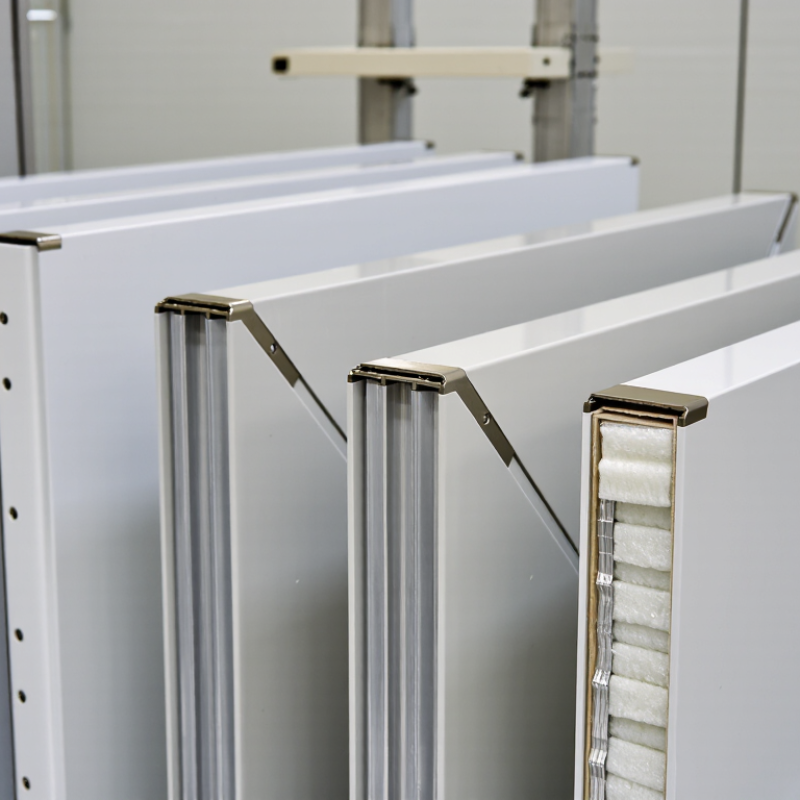
Panel thickness should follow the room’s clear span, pressure conditions, and expected impact—not a rule that thicker is always safer. A long ceiling bay may need a deeper panel or closer supports, while a short wall run may not. Check the full panel build-up, including face sheets and core, because thickness alone does not describe stiffness. That detail matters. For handmade panels, confirm actual dimensions and flatness before installation; small variations can complicate alignment.
Joint design affects both cleanliness and performance. Look for joints that close evenly, leave few ledges, and can be sealed without creating hard-to-clean gaps. A sample corner or short mock-up can reveal awkward seams before the whole room is built. Not glamorous, but useful. Support plans should identify panel spans, connection points, and loads from lights, filters, or service equipment. Do not assume a ceiling panel can carry suspended items just because it feels rigid. Have the loads and fixing details checked by a qualified project professional. I would also leave room to revisit assumptions: equipment layouts change, and an early support plan can become outdated.
Check Surface Cleanability and Compatibility with Cleaning Agents
2026 How to Choose Handmade Cleanroom Panels
Check Surface Cleanability and Compatibility with Cleaning Agents
A cleanroom panel can look smooth yet still hold residue around seams, corners, or fasteners. Inspect the finished surface under bright light. Look for pinholes, rough welds, scratches, and uneven sealant. These small defects can make wiping less reliable.
Check that the surface tolerates the actual cleaning agents used at your facility. Request written compatibility data for the panel’s facing, coatings, and joint materials. Then compare it with your disinfectant’s concentration, contact time, and application method. A chemical may be suitable at one dilution but damage a finish when left wet too long. Test a sample panel when possible. Check for discoloration, softening, swelling, or a change in gloss.
Handmade panels may vary slightly from one production batch to another. That matters at joints, where cleaner can collect if edges do not align. Ask how surface finish and seams are inspected, and whether repairs use compatible materials. Don’t rely on appearance alone. A very smooth finish is not automatically easy to clean if it scratches during routine wiping. Keep the cleaning procedure realistic: use the intended cloth, follow the specified dwell time, and inspect the surface after repeated cycles. Compatibility claims still need checking against your own cleaning routine.
2026 How to Choose Handmade Cleanroom Panels: Surface Cleanability and Cleaning-Agent Compatibility
Indicative compatibility screening for common panel surfaces and cleaning agents. Scores are qualitative guidance (1 = poor, 5 = good), not laboratory test results; actual compatibility depends on the specific finish, concentration, contact time, and cleaning procedure.
Smooth, nonporous finishes and sealed joints are generally easier to clean. Check the panel supplier’s chemical-resistance data before using disinfectants—especially chlorine-based products—and follow the cleaning-agent manufacturer’s instructions.
Verify ASTM E84 Class A Ratings: Flame Spread ≤25, Smoke Developed ≤450
When choosing handmade cleanroom panels, verify the ASTM E84 report for the exact panel construction. Class A means a flame spread index of 25 or less and a smoke developed index of 450 or less. Check that the report covers the panel’s core, facings, coatings, and adhesives—not just a similar material. Small changes can matter. A neat product sheet is useful, but it cannot replace test documentation from a qualified laboratory.
Ask for the report number, test date, and tested assembly details. Then compare those details with the panels being quoted, including thickness and surface finish. Labels reassure. They do not prove everything. ASTM E84 results describe performance under specific test conditions; they do not, on their own, establish a panel’s suitability for every cleanroom or installation. Review seams, joints, and penetrations too, since gaps around a wall opening can affect the finished assembly. It is easy to focus on the rating and overlook the installation. That deserves a second look. Keep the documentation with project records, and have the design team confirm that the stated ratings meet the project’s specifications.