Choosing a Stone Frying Pan in 2026 takes more than trusting a speckled finish or a “natural stone” label. The term often describes a coating, not a pan carved from stone. That distinction matters when comparing durability, heat response, and care. A glossy surface can look convincing under shop lights, yet its performance depends on the pan’s construction and coating quality.
Cookware materials expert Dr. Bryan Quoc Le offers a useful reminder: “A pan’s performance comes from its materials and design, not its name alone.” Treat that as a principle, not a guarantee. Check the manufacturer’s coating details, base material, handle attachment, and care instructions. Then picture your daily cooking: eggs sliding from the surface, vegetables browning over steady heat, and the pan cooling beside the sink. Small details matter.
This guide explains how to compare Stone Frying Pan options without getting distracted by vague claims. It looks at heat distribution, coating wear, compatibility with your cooktop, and practical cleaning needs. It also separates useful features from decorative language. One caveat: even careful reviews cannot predict how every coating will age in every kitchen. Use gentle utensils, avoid sudden temperature changes, and follow the maker’s instructions. A pan may still disappoint. That is worth admitting before you buy.
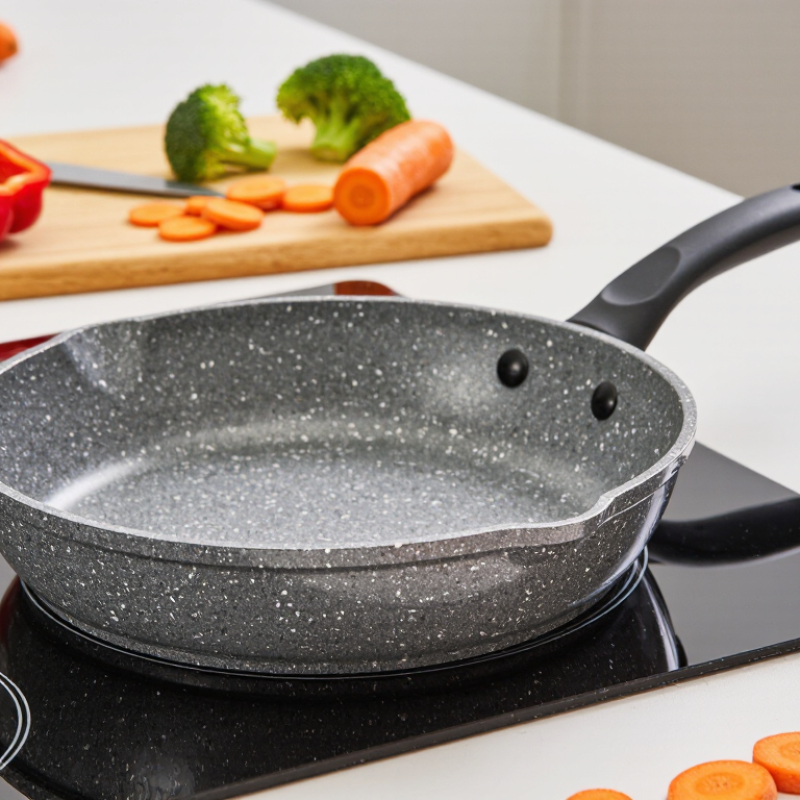
The word “stone” on a frying pan usually describes its appearance or coating style, not a pan carved from rock. That label can mislead. Many stone pans use a PTFE-based nonstick layer, sometimes with mineral particles or a speckled finish. PTFE is the slippery polymer doing much of the release work; decorative flecks do not automatically make it tougher. At breakfast, an egg may release neatly with a little oil, but a metal spatula can still damage some surfaces. I check care instructions, not just the rugged-looking pattern.
Sol-gel ceramic coatings are different. They are generally made from silica-based material, applied as a liquid and cured into a ceramic-like layer. “Ceramic” here does not mean the whole pan is fired clay. These coatings are often sold as PTFE-free, but verify the stated composition instead of guessing from the label. A new pan may release pancakes easily; performance can fade with wear, harsh scrubbing, or repeated high heat. Neither coating is indestructible. For either type, avoid heating an empty pan for long and use utensils suited to its instructions. I still find the word stone a little too reassuring.

When comparing a stone frying pan, treat “stone” as a finish description, not proof of its composition. Many pans use a metal body with a stone-effect coating. Check the product information to identify the food-contact materials, including the cooking surface, rim, and any exposed parts. Small details matter.
Under EU Regulation (EC) No 1935/2004, food-contact articles must not release substances at levels that could endanger health, unacceptably alter food, or affect its taste or smell. Ask the seller for documentation supporting compliance for the finished pan. Useful evidence may include a declaration of compliance where applicable, traceability details, and migration-test results tied to the intended foods and use conditions. There is no single universal EU “certificate” that proves every pan is safe. Paperwork matters.
Check whether tests reflect real cooking: repeated use, high temperatures, and contact with oily or acidic foods can differ from a brief test. A pan tested only under mild conditions may not tell the whole story. I would also look for clear care instructions, since scratched or damaged coatings can make a pan unsuitable for continued use. This point is easy to overlook. If the seller cannot explain what the coating contains or provide relevant compliance evidence, consider another pan. A polished product page is not the same as verifiable documentation.
When comparing stone-finish frying pans, read the care label rather than trusting “stone” in the name. Many PTFE-coated pans cite 260°C (500°F) as a continuous-service ceiling, but this figure is not universal. It applies to the specified coating and use conditions; oven limits, lids, and handles may have lower ratings. Small detail, big difference.
Treat 260°C as a limit, not a cooking target. An empty pan on a powerful burner can heat quickly, especially during long preheating. Use low-to-medium heat for eggs, pancakes, and delicate fish, adding food or a little oil before the pan gets hot. Do not guess. A wisp of smoke signals excessive heat risk, though smoke is not an accurate thermometer.
Check the product instructions for maximum stovetop and oven temperatures, and use a timer while preheating. For sustained high heat or hard searing, a PTFE surface may be a poor match; choose cookware rated for that task. The coating’s condition matters too: stop using a pan if it is deeply scratched, flaking, or damaged. It is easy to check the pan and overlook its handle or lid ratings.
A stone frying pan’s coating does not determine whether it works on induction. The base does. Induction hobs create heat through a magnetic field, so the pan needs a ferromagnetic layer, commonly iron or magnetic stainless steel. Without it, the hob may not detect the pan. No magnetic layer, no heat.
Before buying, check the pan’s specifications for explicit induction compatibility. A small magnet can offer a quick screening test: hold it against the outside of the base. If it sticks firmly, the pan may work, but that test alone cannot confirm even heating or reliable hob detection. I still check twice. A curved or uneven base can wobble on glass and make poor contact, even when magnetic.
Efficiency is another reason to match the pan correctly. The U.S. Department of Energy’s technical analysis of cooking products uses typical cooking-efficiency figures of about 85% for induction, 75% for electric resistance, and 32% for gas. These are test-based estimates, not a promise about every kitchen. For practical results, choose a flat, sturdy base sized to your hob’s cooking zone. Look for clear compatibility information, and treat vague “stone” descriptions cautiously: they usually describe the coating, not the pan’s magnetic core.
| Pan Base or Construction | Induction Hob | Gas Hob | Electric Coil or Radiant-Ceramic Hob | What to Check Before Buying |
|---|---|---|---|---|
| Aluminum body with stone-effect nonstick coating | Not compatible unless it has a magnetic base layer or induction-ready plate. | Generally compatible; use a flat base and keep flames within the pan’s base. | Generally compatible; a flat, stable base helps provide even contact. | Look for explicit induction compatibility. The coating’s “stone” description does not indicate whether the pan works on induction. |
| Aluminum body with bonded magnetic stainless-steel base | Usually compatible when the magnetic layer is designed for induction and makes good contact with the hob. | Generally compatible. | Generally compatible. | Check the manufacturer’s hob-compatibility instructions and make sure the base is not warped. |
| Magnetic stainless-steel body or base | Usually compatible if the magnetic area is large enough and the pan is marked for induction. | Generally compatible. | Generally compatible. | Stainless steel is not always magnetic. A magnet test can be a useful preliminary check, but follow the product’s stated compatibility. |
| Nonmagnetic stainless-steel or aluminum base without an induction plate | Not compatible on its own. | Generally compatible. | Generally compatible. | For induction use, choose a pan with a suitable ferromagnetic layer or a purpose-built induction-compatible base. |
| Cast-iron base or body with a stone-effect coating | Usually compatible because cast iron is magnetic; confirm the pan is labeled for induction. | Generally compatible; avoid overheating the handle or coating. | Generally compatible; lift rather than slide the pan across a glass-ceramic surface. | Check the pan’s weight, base flatness, coating care instructions, and hob guidance. |
| Thin, uneven, or visibly warped base | May heat poorly or fail to be detected, even if part of the base is magnetic. | May heat unevenly. | May make poor contact and heat unevenly, especially on glass-ceramic surfaces. | Choose a stable, flat base sized appropriately for the cooking zone. |
Key point: “Stone frying pan” commonly describes a stone-effect coating or finish, not a solid-stone pan. Hob compatibility depends mainly on the pan’s base construction. For induction, the base must contain magnetic material; always verify the manufacturer’s compatibility information.
A stone-style frying pan is only as dependable as its care instructions and warranty. Before buying, check whether the coating needs low or medium heat, hand washing, or a particular utensil type. Some pans tolerate more than others, so do not assume “stone” means scratch-proof. A silicone spatula and a soft sponge are safer choices for many coated surfaces. Avoid heating an empty pan for long; sudden, intense heat can shorten a coating’s useful life. Small details matter.
Read the warranty terms closely. Check how long coverage lasts, what counts as a defect, and whether normal wear, overheating, or dishwasher use is excluded. Keep the receipt and care booklet, or save clear photos of them. If the pan develops peeling or deep scratches, stop using it and ask the seller or manufacturer about the stated replacement process. Cosmetic marks may not qualify. The wording can be frustratingly narrow.
Replace a pan when its cooking surface is visibly flaking or food repeatedly sticks despite sensible care. A little discoloration alone may not mean it has failed; consult the care guide before deciding. I would not judge durability from a few early uses. Coatings age unevenly, and daily habits are easy to underestimate. A clear warranty and realistic replacement guidance can matter as much as the pan’s first impression.
Copyright ©2024 Elephant Lifting Products | All rights reserved.
38381 N Robert Wilson Rd, Gonzales, LA 70737 USA
Toll Free: (888) 844-6113 | Phone: (225) 644-6113 | Fax: (225) 644-6695
Email: sale@floralift.org