2026 How to Choose a Mattress Quilting Machine?
Choosing a Mattress Quilting Machine in 2026 requires more than comparing speed, price, and promotional claims. Manufacturers now face varied mattress sizes, recycled fabrics, foam combinations, and tighter delivery schedules. The right machine must match your production reality, not an idealized factory plan.
Mattress machinery consultant John R. Galligan offers a practical reminder: “The best quilting machine is the one your operators can run consistently, maintain quickly, and trust under pressure.” That principle deserves attention. A machine may advertise 3,000 stitches per minute, yet unstable fabric feeding can damage patterns and increase waste. Ask how accurately it handles thick borders, elastic materials, and changing mattress widths. Inspect the needle system, quilting depth, servo control, software interface, and pattern library. Small details matter.
Experience also exposes uncomfortable truths. A cheaper machine can become expensive when spare parts arrive slowly. A sophisticated system can underperform when operators receive limited training. Brochures rarely show thread breaks at midnight. They also do not reveal how easy cleaning feels after a long shift. Consider local technical support, warranty terms, energy use, noise levels, and realistic maintenance costs. Request production samples using your own ticking and padding. Measure pattern accuracy, seam stability, and operator comfort.
There is no universal winner. Your workforce, floor space, product range, and future expansion plans should guide the decision. Leave room for doubt. Test carefully, question impressive numbers, and choose dependable performance over dramatic promises.
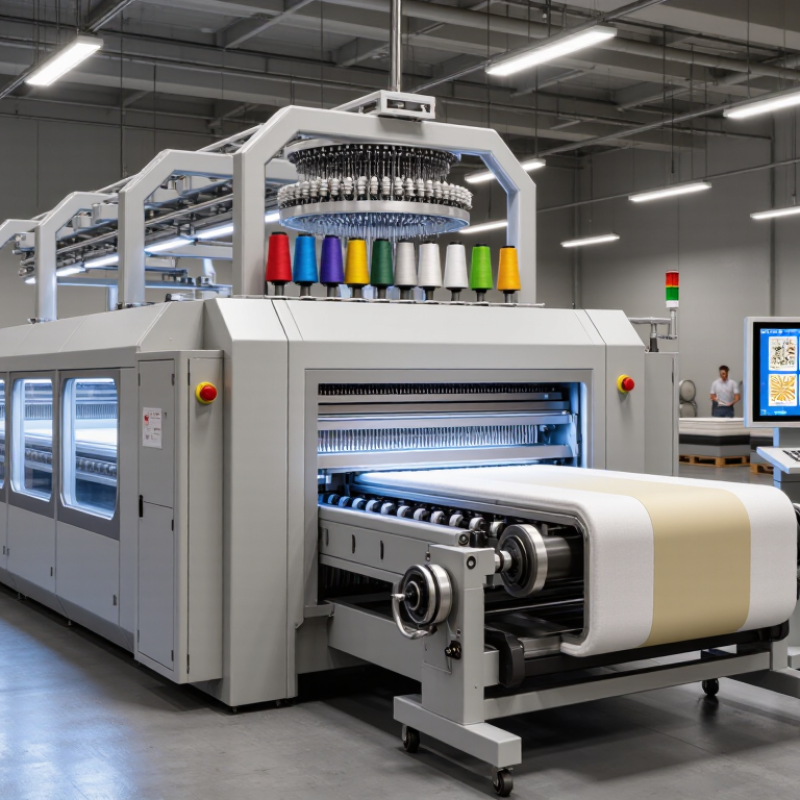
Define Mattress Quilting Machines by Type, Structure, and Use Case
How to Choose a Mattress Quilting Machine?
Mattress quilting machines should be defined by type, structure, and use case. Single-needle machines suit small batches, samples, and frequent pattern changes. Multi-needle systems produce wider, faster quilting for stable production schedules. Computerized models add programmable patterns, automatic fabric control, and repeatable stitch spacing. Start with the quilt.
According to Grand View Research’s Mattress Market Size, Share & Trends Analysis Report, the global mattress market was valued at about USD 51.7 billion in 2023.
The report also projects continued growth through 2030. This expansion increases pressure on factories to improve consistency, not simply speed.
A machine’s structure deserves close inspection. Check the needle beam, fabric rollers, tension system, frame rigidity, drive motor, and control panel.
Uneven roller pressure can create ripples across a finished mattress panel. That flaw is easy to miss under bright factory lighting.
Use case should guide the final choice.
A foam mattress producer may need broad quilting widths and stable continuous feeding. A custom workshop may value quick pattern changes over maximum output. Compare stitch length, working width, fabric thickness, noise, maintenance access, and operator training.
The International Sleep Products Association’s 2024 market reporting highlights ongoing changes in bedding demand and product mix. That makes flexibility increasingly valuable.
Still, the fastest machine is not always the best investment. A practical trial with your own ticking fabric may reveal tension problems that a specification sheet hides.
Compare 1,500–3,000 RPM Sewing Speeds and 2,000–2,500 mm Widths
Choosing a mattress quilting machine starts with production reality, not the highest advertised RPM. Grand View Research’s 2024 mattress market report valued the global market at approximately USD 51.6 billion in 2023. That scale increases pressure for stable, repeatable output. However, 3,000 RPM is not automatically better than 1,500 RPM. At a 2 mm stitch length, 1,500 RPM suggests about 3 meters of theoretical stitching per minute. At 3,000 RPM, the figure reaches 6 meters. Actual output falls because of pattern turns, thread trimming, fabric movement, and machine pauses. Speed is not everything.
A 2,000–2,500 mm quilting width suits many mattress panels and reduces repositioning. The extra 500 mm can matter when quilting thick borders or layered comfort materials. Yet wider frames demand stronger fabric control and more floor space. ISO 4915 stitch classifications help buyers compare stitch structures, but they do not prove finished-panel quality. Check stitch consistency at working speed, not during an empty demonstration. A practical mistake is trusting the maximum RPM label. I have seen high-speed settings create vibration, uneven tension, and needle heating. That lesson is easy to ignore. Request production samples using your actual foam, ticking, batting, and thread. Compare speed, noise, skipped stitches, edge accuracy, and operator adjustments. A slower machine may produce more saleable panels per shift. Reconsider the choice after measuring downtime, not only the number on the control panel.
2026 How to Choose a Mattress Quilting Machine?
Compare 1,500–3,000 RPM Sewing Speeds and 2,000–2,500 mm Quilting Widths
The chart compares representative industrial mattress quilting configurations within common specification ranges. Higher sewing speed can improve production throughput, while a wider quilting area supports larger mattress panels and reduces the need for repeated positioning. Actual output depends on stitch length, pattern complexity, material thickness, operator settings, and machine duty cycle.
Match Needle Count, Stitch Length, and 2–10 mm Pattern Requirements
Choosing a mattress quilting machine in 2026 starts with three measurable details: needle count, stitch length, and pattern range.
The 2024 International Sleep Products Association industry data shows that U.S. mattress shipments remain above 30 million units annually. High output demands stable quilting, but volume alone should not decide the machine.
Needle count should match quilt width, fabric layers, and desired pattern density.
More needles can improve productivity, yet excessive density may compress foam or create visible puckering. For standard mattress panels, test 2–4 mm stitches for dense surface control. Use 5–7 mm when balancing softness, strength, and production speed. A 10 mm stitch suits open decorative patterns, but it may look weak on thin ticking fabric. Test the swatch.
Pattern flexibility matters.
A machine covering the full 2–10 mm range can handle firm borders, smooth transitions, and larger geometric designs. The Textile Exchange Materials Market Report 2024 identifies polyester as a dominant fiber in global textile production, so thread tension and heat control deserve careful checking.
Polyester layers can respond differently from cotton-rich fabrics. I would not trust a catalog setting without testing actual production materials.
Record needle spacing, thread type, presser pressure, and speed. Then inspect skipped stitches, distortion, and compressed filling after washing or handling. Small errors become expensive across thousands of panels.