
Choosing Rockwool Density is not a matter of selecting the highest number on a product sheet. Density, usually stated in kilograms per cubic metre, affects handling, stiffness, and suitability for specific assemblies. It does not, by itself, tell you the insulation’s thermal resistance or acoustic performance. The right choice depends on where the material will sit: between timber studs, beneath a roof, inside a partition, or under a floor that carries loads. A board that feels firm in your hand may still be the wrong fit. Small gaps matter.
The scale of the decision is real. The 2023 Global Status Report for Buildings and Construction, published by UNEP and the Global Alliance for Buildings and Construction, estimates that buildings and construction account for about 34% of global energy-related CO₂ emissions. Insulation can help reduce building energy demand, but only when its properties match the assembly and installation conditions. Building-science researcher John Straube’s guidance can be summarized this way: “Judge insulation as part of the whole assembly, not by one number alone.” This is a paraphrase, not a verbatim quotation. Check manufacturer datasheets for declared thermal conductivity, density, thickness, and intended use; compare products on the same basis. Then consider moisture exposure, compression, fire requirements, and installation quality. The details are easy to overlook. I would not pretend one density suits every project. That shortcut sounds useful, but it can lead to poor choices.
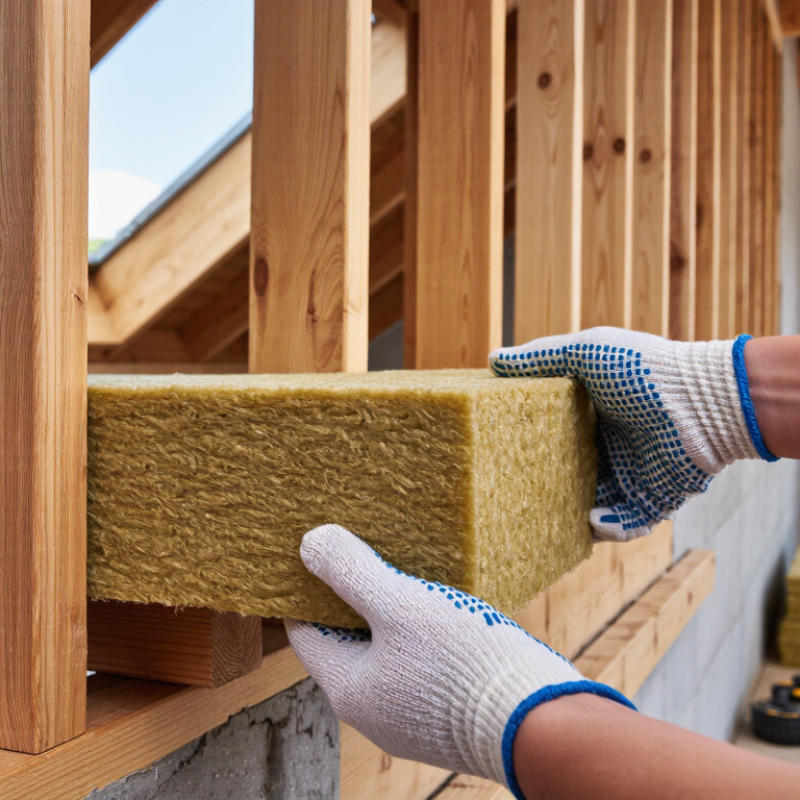
Density is the mass of insulation divided by its volume, usually expressed in kilograms per cubic metre (kg/m³). It describes how much material occupies a given space; it does not directly tell you how well a product insulates. ASTM C612 classifies mineral-fiber board types with nominal maximum densities from 4 to 32 lb/ft³, roughly 64 to 513 kg/m³. That broad range reflects different product uses, not a single ideal density. EN 1602 sets out a method for measuring the apparent density of thermal insulation products.
Why should installers care? Density can affect a board’s stiffness, handling, and ability to stay in place. It can also matter in acoustic assemblies, where thickness and installation details influence performance alongside density. But denser does not automatically mean warmer or quieter. Thermal conductivity also depends on factors such as fiber structure and test conditions. A useful reminder.
For a concrete check, a 0.6 × 1.2 × 0.1 m board has a volume of 0.072 m³. At 80 kg/m³, its mass is about 5.8 kg.
Compare the declared density with the design load and installation method, then review the product’s tested thermal and acoustic data. Density alone is an incomplete shortcut; it is easy to overlook that.

Rockwool density changes heat flow, sound absorption, and resistance to compression, but it does not improve all three equally. The ASHRAE Handbook—Fundamentals gives mineral-fiber insulation thermal conductivity values broadly around 0.034–0.045 W/(m·K), depending on product and test conditions. Higher density can reduce air movement inside the material, yet added solid-fiber contact may also conduct heat. The difference is often modest. Check declared conductivity, not density alone.
Acoustically, thickness and installation matter as much as density. ASTM C423 test reports for 50-mm mineral-wool specimens show that sound absorption can approach an NRC of 1.0 with suitable mounting and an air space; this is not a guaranteed wall rating. For a partition, a snug friction fit helps limit gaps, while an air cavity can improve absorption. Mechanically, denser slabs generally resist handling and compression better. EN 13162 therefore declares compressive stress for applicable products, giving designers a more useful load check than density by itself. I would not treat one density chart as a universal answer. It rarely is. Check the tested assembly and the actual support conditions.
Rockwool density should match the job, not just a number on a package. For timber-frame walls and attic spaces, lighter batts can fit between studs or joists without adding unnecessary load. A snug fit matters: gaps around a pipe or compressed corners can undermine insulation performance. It depends.
For internal partitions, medium-density slabs can provide a firmer fit and help reduce sound transfer between rooms. They are easier to handle than very rigid boards, though cutting still creates dust; use suitable protective equipment and follow the product instructions. For external walls, choose boards approved for the specific facade system. Wind exposure, fixing method, and finish all affect suitability.
Flat roofs and floors often need denser, more rigid boards to resist loads and maintain shape beneath roofing layers or floor finishes. But density alone does not tell you how well a product insulates. Compare declared thermal conductivity, thickness, fire classification, and compressive strength against the project specification. Check the details. I have seen density treated as a shortcut, and it can be misleading: two products with similar density may perform differently. Confirm the required specification with the designer or manufacturer, especially where loads or moisture exposure are significant.
Density ranges shown are indicative examples in kg/m³, not universal specifications. Actual product ranges vary by system and supplier. Choose insulation based on the project’s thermal, acoustic, fire, moisture, and load requirements, and verify the product specification and applicable local standards.
2026 How to Choose the Right Rockwool Density?
Match density to the actual load, not just a catalog number. For a stud wall, flexible batts should fit the cavity without gaps or excessive compression. Roof decks and service areas may need rigid boards with documented compressive strength. Density alone does not prove load capacity. Check test results, including ASTM C165 compression data, against expected loads from people, equipment, or supports.
Climate changes the specification. The U.S. DOE Energy Saver guidance gives attic insulation recommendations ranging from R-30 to R-60 across climate zones. Reach the required R-value through thickness and declared thermal performance, not density alone. In cold, damp assemblies, consider vapor control and drying paths before choosing a denser board. A tightly fitted batt can still leave thermal bridges at studs. And a heavy board may not suit a weak substrate.
Tips: Check density, thickness, compressive strength, and moisture limits on the product test sheet. For roofs, compare design loads with tested performance, including concentrated loads beneath supports. For walls, prioritize fit and continuous coverage. There is no perfect density chart; site conditions can change the answer, so verify the assembly details.
Check the technical data sheet before comparing Rockwool density. Record the product’s declared density in kg/m³, thickness, and thermal conductivity, shown as λ in W/(m·K). Compare products at the same thickness and under the same test method; otherwise, the numbers may not describe an equivalent installation. EN 13162 covers factory-made mineral-wool products, while EN 12667 specifies a method for measuring thermal resistance and conductivity. Not the whole story.
Match other specifications to the job. For a floor, check compressive strength and stated load conditions. For a cavity or partition, check dimensions, fit, and any declared acoustic performance. Review water absorption, fire classification, and tolerances where they matter to the assembly. Density alone does not prove better insulation or sound control. The UNEP and GlobalABC 2024 Global Status Report states that buildings and construction accounted for 32% of global energy demand and 34% of energy-related CO₂ emissions in 2022. Better specification checks can help avoid unsuitable choices, though density is only one part of building performance.
Read the test conditions, not just the headline value. Confirm whether figures apply to the exact product thickness and intended use, then check the installation guidance. A datasheet can look precise while leaving practical questions unanswered. I would still verify that the declared properties match the project’s actual constraints.
| Application | Indicative Density Range (kg/m³) | Specifications to Check | How to Choose |
|---|---|---|---|
| Loft or pitched-roof insulation between framing | Approximately 20–50 | Declared thermal conductivity (λD), thickness, dimensions, and intended installation method | Prioritize the required thermal resistance and a suitable fit between framing. A higher density alone does not guarantee better insulation. |
| Internal partition or acoustic lining | Approximately 30–80 | Thickness, airflow resistivity or relevant acoustic test data, and the tested wall or ceiling assembly | Choose for the complete assembly, including board layers, cavity depth, and framing. Density by itself cannot predict sound reduction. |
| External wall insulation board | Approximately 80–150 | Tensile strength perpendicular to faces (TR), dimensional stability, water absorption, reaction to fire, and system approval | Match the board to the specified façade system and fixing method. Confirm that the declared strength and other properties meet the project requirements. |
| Flat-roof insulation board | Approximately 100–200 | Compressive stress at 10% deformation (CS(10)), point load (PL), thickness, water absorption, and roof-system compatibility | Use the structural or roofing specification to determine the required load performance. Do not select a roof board by density alone. |
| Industrial or equipment insulation | Product-specific; commonly about 40–180 | Service-temperature limits, thermal conductivity at the relevant mean temperature, dimensions, facing, and mechanical requirements | Check the operating temperature and the equipment design. Density ranges vary widely by product form and intended duty. |
| Any application where fire performance is required | Not selected by density alone | Declared reaction-to-fire classification, such as Euroclass under EN 13501-1, and any assembly-level fire requirements | Verify the classification on the product documentation and check whether the requirement applies to the insulation itself or the complete construction. |
| Product-document check before purchase | Compare the declared value with the project specification | Product standard, declared density or density tolerance, λD, thickness tolerance, mechanical properties, fire classification, and water-related performance | Use the current technical data sheet and Declaration of Performance where applicable. Compare products at the same thickness and intended use. |
Copyright ©2024 Elephant Lifting Products | All rights reserved.
38381 N Robert Wilson Rd, Gonzales, LA 70737 USA
Toll Free: (888) 844-6113 | Phone: (225) 644-6113 | Fax: (225) 644-6695
Email: sale@floralift.org