
Choosing among China’s top 10 Electric Distribution Box suppliers takes more than comparing prices or polished product photos. These boxes protect circuits, organize components, and support safe, reliable power distribution in homes, factories, and commercial buildings. A small detail matters: the door should close cleanly, while terminals remain accessible for inspection and maintenance.
Thomas Edison’s familiar words, “Genius is one percent inspiration and ninety-nine percent perspiration,” offer a useful reminder for product engineering. A distribution box succeeds through careful design and testing, not appearance alone. Buyers should check enclosure materials, rated current, ingress protection, thermal performance, wiring space, customization options, and relevant test documentation. Requirements differ by application and destination, so confirm suitability with a qualified electrical professional. Ask suppliers for clear drawings and traceable specifications. Details matter.
This guide compares ten China-based suppliers through practical factors, including product range, manufacturing capabilities, quality controls, communication, and after-sales support. It is a starting point, not a guarantee of performance. A confident sales promise cannot replace a sample review or document check. Even a well-organized catalog may leave unanswered questions about component sourcing or production consistency. That gap deserves attention. Some comparisons also rely on information suppliers publish themselves, which may be incomplete. Readers should verify critical claims directly and assess each supplier against project requirements. The strongest choice is not always the cheapest or largest manufacturer; it is the supplier whose evidence, product design, and service match the job.
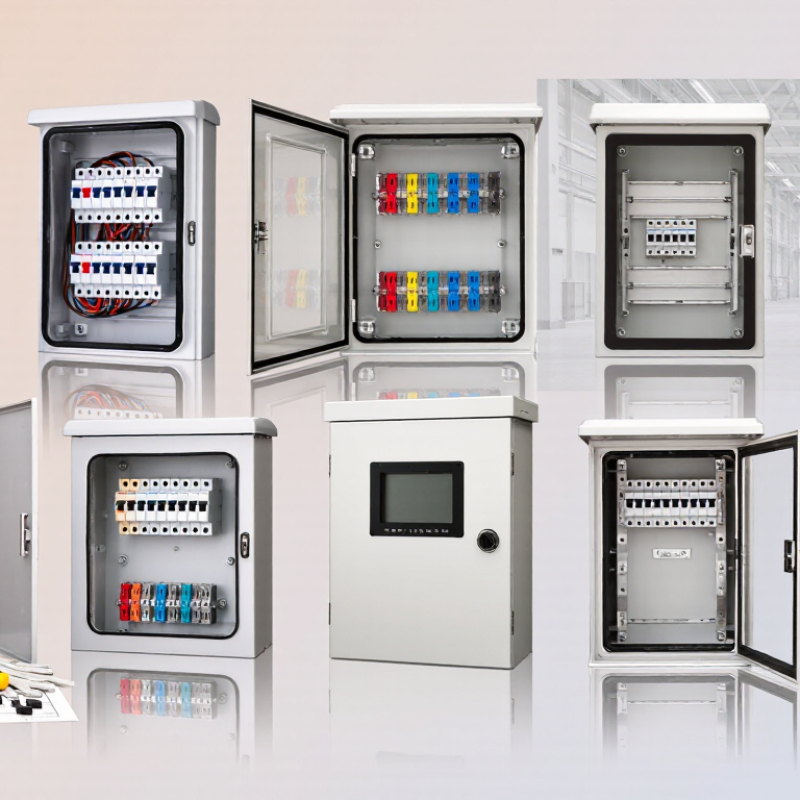
An electric distribution box receives power from an incoming supply and divides it into separate circuits. Inside, components such as circuit breakers, busbars, and terminals help direct electricity and interrupt circuits during overloads or faults. The enclosure also shields live parts from accidental contact, dust, and physical damage. Its size and layout depend on the number of circuits and the electrical load. That matters.
These boxes are used in homes, offices, shops, factories, and utility areas. A home box may serve lighting, kitchen outlets, and air-conditioning circuits. In a workshop, separate circuits can supply motors or equipment with heavier loads. Outdoor or dusty locations need enclosures suited to those conditions. A box is not simply a container; its ratings, wiring space, and access requirements affect safe operation. Real installations can be less tidy than diagrams suggest, so clear circuit labels and careful planning help.
Tips: Check the rated voltage, current capacity, and enclosure protection before selection. Keep circuits clearly labeled, and leave enough space for inspection and maintenance. Installation and testing should be handled by a qualified electrician. Don’t guess. A small mismatch can create heat, nuisance trips, or difficult servicing.

China’s distribution-box industry is influenced by grid upgrades, industrial growth and renewable-energy connections.
In 2024, national electricity consumption reached 9.85 trillion kWh, up 6.8% year on year, according to China’s National Energy Administration (NEA). That demand means more switching, metering and circuit-protection points in factories, offices and homes.
The NEA also reported 373 GW of newly installed renewable capacity that year. Wind and solar facilities need low-voltage panels for auxiliary systems, control rooms and service buildings. Small boxes, everywhere.
Buyers commonly compare rated current, breaking capacity, ingress protection, heat management and spare circuit space. In coastal plants, salty air can damage inadequate coatings; in dusty workshops, blocked ventilation can raise internal temperatures.
Chinese suppliers serve projects ranging from residential boards to customized industrial assemblies, but quality varies. One limitation: national energy statistics track electricity and generation, not distribution-box shipments or replacement cycles. This makes supplier claims harder to compare.
Site checks still matter. Inspect terminal access, wiring labels and test records, not just the enclosure. Sometimes a tidy drawing hides awkward maintenance access.
A useful supplier review starts with the box’s actual operating conditions. Confirm rated voltage, current, short-circuit capacity, enclosure material, and ingress protection against your project requirements. Ask for drawings, component specifications, and test records that match the proposed configuration. Documents should identify model numbers and revision dates. Details matter. A polished brochure is not proof of consistent production, and a mismatch between drawings and delivered equipment can cause costly delays.
Check how the supplier controls quality from incoming materials to final inspection. Request examples of routine test reports, inspection checklists, and corrective-action records, with sensitive customer information removed. Ask who verifies wiring, labeling, clearances, and terminal tightness before shipment. A factory visit or live video inspection can reveal workbench organization and testing equipment, though neither replaces independent verification. One detail is easy to miss: confirm spare-part availability and expected lead times before placing an order. I would also compare communication quality; vague answers deserve follow-up.
Tips: Send the same specification sheet to each candidate. Compare written responses, not just quoted prices. Request a sample drawing and clarify packing, delivery, and after-sales support. If a claim sounds unusually broad, ask what evidence supports it.
These ten profiles offer a practical way to compare electric distribution box suppliers in China. They are capability snapshots, not a verified ranking; product ranges and delivery capacity can change. A residential specialist may prioritize compact enclosures, clear circuit layouts, and tidy cable entry. An industrial supplier may offer larger cabinets, reinforced panels, and room for heat management. Details matter.
A customization-focused maker may adapt dimensions and mounting points to project drawings. An export-oriented supplier may provide clearer packing records and technical documents. A metal-fabrication-led producer may handle sheet thickness and surface finishing in-house. A modular-design supplier may support quicker assembly with standardized components. A project-support supplier may help review diagrams, though response quality should be checked directly.
A cost-focused manufacturer may suit straightforward specifications, but compare material and testing details carefully. A low-volume specialist may handle pilot orders without requiring a large commitment. A broad-catalog supplier may offer residential, commercial, and industrial options under one roof. Ask each candidate for enclosure dimensions, material data, protection ratings, and sample inspection procedures. These checks reveal more than polished catalogs. Some profiles may overlap, and that is a useful reminder: supplier labels alone cannot confirm consistent quality.
| Profile | Typical Product Focus | Common Applications | Configuration Options | Standards to Check | Key Buyer Verification |
|---|---|---|---|---|---|
| 01 — Low-voltage panel specialist | Low-voltage distribution assemblies and panel-mounted equipment | Commercial buildings, industrial facilities, and infrastructure projects | Incoming and outgoing circuits, metering, protection devices, and busbar arrangements vary by design | IEC 61439-1 and the applicable assembly-specific part, such as IEC 61439-2 | Request the assembly’s design-verification evidence and the exact rated current and short-circuit ratings |
| 02 — Modular consumer-unit maker | Compact distribution boards designed for modular circuit-breaker devices | Homes, apartments, and small commercial premises | Surface or flush mounting, circuit count, neutral and earth terminals, and enclosure material | IEC 61439-3 where the assembly falls within its scope; verify applicable local rules | Check device compatibility, terminal capacity, wiring space, and installation instructions |
| 03 — Industrial control-and-distribution integrator | Custom enclosures combining power distribution and control components | Factories, machinery, and process systems | Component layout, control wiring, labeling, and enclosure dimensions are project-dependent | Applicable IEC 61439 requirements and relevant machine or project standards | Confirm drawings, component lists, wiring diagrams, inspection scope, and responsibility for system integration |
| 04 — Weather-resistant enclosure supplier | Distribution boxes for outdoor or demanding environmental conditions | Outdoor equipment, utility sites, and building services | Enclosure material, seals, cable entries, mounting method, and protection level depend on the model | IEC 60529 for IP classification; applicable assembly standards for the completed product | Verify the stated IP rating for the fully assembled configuration, including doors, glands, and unused openings |
| 05 — Sheet-steel cabinet fabricator | Metal distribution cabinets and custom electrical enclosures | Industrial plants, commercial buildings, and electrical rooms | Cabinet size, coating, mounting plate, door arrangement, and cut-outs can be specified | Applicable IEC 61439 requirements for the finished assembly; IEC 60529 if an IP rating is claimed | Check material and coating specifications, fabrication drawings, earthing provisions, and corrosion suitability |
| 06 — Insulating-enclosure specialist | Distribution boxes made with insulating enclosure materials | Residential, commercial, and selected outdoor installations | Enclosure size, transparency, mounting style, and cable-entry arrangement vary by product | Applicable IEC 61439 requirements; IEC 60529 for declared ingress protection | Request material and temperature data, and confirm suitability for the installation environment |
| 07 — Metering and service-distribution supplier | Metering compartments and service distribution assemblies | Building service entrances and project-specific utility installations | Meter positions, compartment separation, and access arrangements depend on local requirements | Applicable assembly standards and the requirements of the relevant utility or authority | Confirm local approval, meter compatibility, sealing arrangements, and service-connection requirements before ordering |
| 08 — Solar and renewable-energy box supplier | Distribution or protection enclosures for photovoltaic and related systems | Solar installations and renewable-energy projects | DC or AC application, isolators, protective devices, and enclosure configuration must match the system design | Relevant IEC standards for the included equipment and assembly; verify project and jurisdictional requirements | Confirm DC voltage and current ratings, polarity, protection-device coordination, and intended system topology |
| 09 — OEM and contract-manufacturing supplier | Customer-specified distribution boxes produced for project or OEM requirements | Equipment manufacturers, panel builders, and private-label projects | Design, branding, components, packaging, and documentation are defined by contract | Standards and certification requirements stated in the approved technical specification | Agree on approved drawings, change control, inspection criteria, traceability, and ownership of certification evidence |
| 10 — Project-focused panel builder | Engineered distribution assemblies supplied against project specifications | Infrastructure, commercial construction, and industrial projects | Ratings, compartments, metering, protection, and monitoring depend on the project schedule | Applicable IEC 61439 parts, project specifications, and local electrical regulations | Review technical deviations, test documentation, delivery scope, spare parts, and commissioning support |
Note: These are anonymous, category-based supplier profiles, not a verified ranking of ten named companies. Product ratings, certifications, IP classifications, and available configurations vary by model; confirm them using current manufacturer documentation and the requirements of the destination market.
Comparing China’s leading electric distribution box suppliers means looking beyond catalog size. The IEA’s 2023 report, Electricity Grids and Secure Energy Transitions, says annual global grid investment needs to exceed $600 billion by 2030, up from roughly $300 billion. That expansion raises the value of suppliers able to deliver consistent production, clear test records, and practical engineering support. Check whether stated ratings match the project’s voltage, current, and fault levels.
Details matter. Ask for IEC 61439 test documentation, temperature-rise results, and short-circuit withstand ratings for the specific assembly—not just a general certificate. Compare enclosure protection ratings, busbar materials, wiring access, and options for adding circuits later. A useful supplier should also explain routine inspection and traceability for components. No certificate tells the whole story. ISO 9001, for example, concerns quality management; it does not by itself prove a particular box meets a project’s electrical requirements. A sample unit can reveal awkward cable entry or cramped terminals. Small things, but they matter. Supplier comparisons are stronger when documents, samples, and production capabilities are checked together.
Representative rated-current classes found across distribution box product ranges
These reference values illustrate common product classes, not a verified ranking or comparison of ten suppliers. Actual ratings depend on the product configuration and manufacturer documentation. Confirm applicable IEC 61439 requirements and model-specific compliance when evaluating suppliers.
Copyright ©2024 Elephant Lifting Products | All rights reserved.
38381 N Robert Wilson Rd, Gonzales, LA 70737 USA
Toll Free: (888) 844-6113 | Phone: (225) 644-6113 | Fax: (225) 644-6695
Email: sale@floralift.org