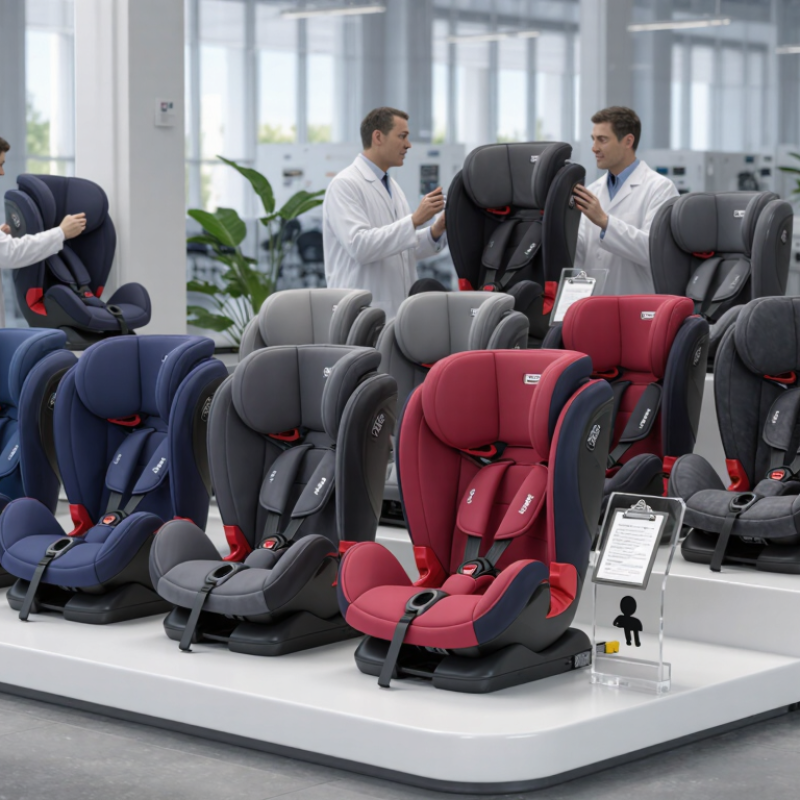
Global buyers need more than a supplier name when comparing Booster Seat manufacturers in China. They need clear evidence of product quality, dependable communication, and production capacity that matches their order plans. As child passenger safety expert Dr. Benjamin Hoffman is widely quoted: “The best car seat is the one that fits your child, fits your vehicle, and that you will use correctly every time.” That principle matters when evaluating a booster seat’s fit, labeling, instructions, and practical design—not just its price or appearance.
This guide introduces leading Chinese manufacturers and the questions buyers should ask before shortlisting them. It looks at factory experience, material choices, quality-control processes, customization options, and export support. Ask for current product documentation and clear details about testing; a polished catalog alone proves little. Look closely at the seat’s belt guides, fabric seams, and adjustment points. Small details count. Supplier claims should be checked against records, samples, and consistent answers from the sales and quality teams. A factory visit can help, though it may not reveal every production risk. No shortlist is perfect. Buyers should also consider communication delays, order minimums, lead times, and after-sales support. The sections ahead provide a practical starting point for comparing manufacturers, while reminding readers to verify each supplier’s capabilities directly.
For children measuring 100 to 150 cm, UN R129 classifies suitable child restraint systems by height rather than age. Many products in this range are booster seats used with a vehicle’s three-point belt. The belt should lie low across the pelvis and cross the shoulder without touching the neck. Small details matter. R129 includes side-impact requirements, but approval does not guarantee a perfect fit in every vehicle.
Global buyers should check the approval label, permitted height range, and instructions for each model. Confirm how the seat is secured and whether it is approved for the intended vehicle. ISOFIX connectors can help hold some boosters in place, while the vehicle belt restrains the child in the approved setup. A hands-on fit check is useful: belt guides, seat shape, and head-restraint position can change how the belt sits. Paperwork may look complete, yet a belt can ride too high in a particular car. Test samples across different vehicle seats, and keep test records and production traceability available for review.
A Chinese booster-seat manufacturer should be judged by the approval of each specific model, not by a factory-wide claim. UN R129 and China’s GB 27887 set different requirements, so a seat tested against one should not be assumed to meet the other. Ask suppliers for the model’s approval documents, test reports, and photographs of its permanent label. Check that the model number, height range, and production version match across all records. Small mismatches matter.
Look closely at how the seat is made. A useful factory review may include checking stitching, belt guides, shell edges, and packaging labels against approved samples. Request traceability records and details of quality checks during production, not only a polished sample. For GB 27887, confirm the applicable standard edition and evidence for the exact product being offered. For UN R129, verify the relevant approval and permitted child-height range. Paperwork can look convincing. It still needs checking.
Some suppliers may have capable engineering teams but limited experience with export-market documentation. That is worth discussing openly. Ask who handles testing, how design changes are controlled, and whether buyers are notified before components change. A careful answer is more useful than a broad promise of compliance.
Top Booster Seat Manufacturers in China for Global Buyers
Under UN Regulation No. 129 (R129), backless booster cushions are approved for children at least 125 cm tall. This minimum changes how buyers should assess product ranges. A backless cushion may look compact and practical, but it does not provide the upper-body support of a booster with a backrest. The 125 cm threshold is an approval requirement, not a guarantee that a particular seat fits every child or vehicle. That distinction is easy to miss.
For global buyers, check the product label, approved height range, and installation instructions. Also review how the vehicle’s belt sits: the lap belt should rest low across the hips, while the shoulder belt should cross the chest without touching the neck. A child’s height matters more than age alone. Vehicle seat shape and belt position matter too. A tidy specification sheet cannot show every real-world fit.
Tips: Ask suppliers for current R129 approval documents and clear height-range markings. Test fit with the intended vehicle when possible. If the shoulder belt rides near the face, reconsider the seat choice. Height alone is not enough.
| Comparison Dimension | Established Reference Point | What Global Buyers Should Verify with a Manufacturer | Why It Matters |
|---|---|---|---|
| Product and Regulatory Requirements | |||
| R129 minimum stature for booster cushions | Under the applicable UN Regulation No. 129 requirements, booster cushions without a backrest are for children at least 125 cm tall. Check the relevant R129 series, approval documents, and transition provisions for the specific product. | Request the complete type-approval documentation and confirm the approved stature range for the exact model and configuration being purchased. | The 125 cm threshold is a key distinction for backless boosters; it should not be assumed to describe every booster seat with a backrest. |
| Backless versus high-back design | A backless booster raises the child so the vehicle’s three-point belt can fit more appropriately. Unlike a high-back booster, it does not provide an integrated backrest or side wings around the child’s head and torso. | Check the intended age and stature range, seat geometry, belt-routing features, and compatibility instructions for the target vehicle markets. | Families must follow the product instructions and vehicle manual; the child is restrained by the vehicle belt, not by a booster harness. |
| Vehicle-belt use | Booster cushions are designed to be used with the vehicle’s seat belt. A booster does not replace the belt or make an unsuitable belt position acceptable. | Review user instructions and test how the lap and shoulder belt pass across the child in the intended seating positions. | Correct belt fit is central to the intended function of a booster seat. |
| ISOFIX or lower-anchor connectors | Some boosters include connectors that attach the booster to vehicle anchor points. The child is still restrained by the vehicle belt, unless the specific approved product instructions state otherwise. | Confirm whether connectors are included, which vehicle anchors they use, and how the seat is secured when unoccupied. | Connector availability and function vary by model; they should not be presented as a replacement for the vehicle belt. |
| Type approval and product marking | UN R129 approval applies to a defined product type and configuration. The approval marking and documentation should correspond to the product offered for sale. | Match the approval number, product model, label, instructions, and bill of materials. Ask about approval status before any design or material change. | A general statement that a factory “makes R129 seats” does not establish that a particular model is approved. |
| Market-specific compliance | Regulatory requirements and accepted approval routes can differ by destination market. UN R129 documentation alone should not be treated as proof of compliance with every country’s import or retail rules. | Confirm the required approvals, labels, language versions, importer obligations, and testing documentation for each destination country. | Market access depends on the product and destination, not just the supplier’s general compliance claims. |
| Manufacturer Due Diligence for Global Buyers | |||
| Factory quality management | ISO 9001 is a quality-management-system standard; it is not a child-restraint product approval. | Verify certificate scope, issuing body, validity, and whether the certified site is the facility that will make the order. Request a quality-control plan and traceability process. | Management-system certification and product type approval answer different questions. |
| Testing and change control | Safety-related design, materials, components, or manufacturing changes may affect conformity to the approved product type. | Ask how the manufacturer controls changes to foam, plastics, covers, labels, suppliers, tooling, and production sites, and how changes are reviewed for approval impact. | Uncontrolled substitutions can create differences between the approved sample and mass-produced goods. |
| Production inspection and traceability | Inspection methods, sampling plans, and traceability arrangements are supplier-specific and should be confirmed rather than assumed. | Agree on incoming, in-process, and final inspection records; batch or lot identification; defect handling; and access to production records. | These controls help buyers investigate quality issues and maintain consistent shipments. |
| Documentation and packaging | Product labels, warnings, instructions, and packaging must match the approved configuration and applicable destination-market requirements. | Review artwork and translations before production. Check model identification, approval references, care instructions, and required warnings against the final product. | Documentation errors can cause compliance, customs, or consumer-use problems even when the physical product is unchanged. |
| Commercial capability and capacity | Minimum order quantities, lead times, tooling ownership, and available production capacity vary by manufacturer and order specification. | Request written quotations, sample and production schedules, capacity evidence, tooling terms, and contingency plans for material or component delays. | These are commercial facts to confirm for each supplier; they should not be inferred from a product catalogue. |
| Supplier comparison method | No single certificate or factory claim establishes that a supplier is the best fit for every buyer or market. | Compare document completeness, audit findings, sample conformity, communication, change control, delivery performance, and destination-market experience. | A documented, model-specific assessment is more useful than ranking suppliers by unsupported capacity or quality claims. |

When comparing booster seat manufacturers in China, buyers should look beyond a polished test report. Ask which checks are performed on each production lot and which apply only to initial samples. Useful records may include material inspections, dimensional checks, buckle-function tests, and documented corrective actions. Request a recent sample report and confirm that its model and materials match the product being quoted. Details matter.
Factory testing is only one part of the picture. Buyers should clarify how a supplier handles custom fabrics, packaging, labels, and tooling changes. A small pilot run can reveal whether approved specifications reach the sewing and assembly lines. Ask who signs off on changes and how rejected parts are separated. A capable OEM partner can explain its process clearly, though a smooth presentation does not prove consistent production. No audit catches everything.
Export experience also shows in everyday coordination. Ask about previous shipments to your target region, typical production timelines, carton testing, and document preparation. Request examples of packing lists and inspection records with confidential details removed. Check whether the factory can track batch numbers from finished cartons back to production records. Clear answers are useful; vague promises deserve follow-up. The buyer’s own checklist may need revision after the first sample review.
A printed E-mark is only a starting point. Ask the supplier for the full type-approval certificate, approval number, issuing authority, and the exact seat model and configuration covered. Check that labels, instructions, and submitted samples match the certificate. Confirm which UN regulation and destination-market requirements apply; approval for one model does not automatically cover every variation. Paperwork can look tidy while details are missing.
Request complete crash-test records, not just a pass statement. Look for the test standard and version, laboratory identification, test date, sample configuration, and results for each relevant test. WHO’s Road traffic injuries fact sheet reports that correctly used child restraints can reduce fatal injuries by 71% for infants and 54% for small children. That is why matching the tested configuration matters. A brief test summary may be useful, but it is not the full record.
Get MOQ and lead times in writing, separated by model, fabric, packaging, and order quantity. Ask whether the quoted schedule includes sample approval, production, inspection, and shipping preparation. Request recent production examples and a capacity plan for your order period. A neat spreadsheet helps, but it cannot prove real factory capacity. Build in time for revisions; delays happen, and buyers sometimes underestimate them.
Copyright ©2024 Elephant Lifting Products | All rights reserved.
38381 N Robert Wilson Rd, Gonzales, LA 70737 USA
Toll Free: (888) 844-6113 | Phone: (225) 644-6113 | Fax: (225) 644-6695
Email: sale@floralift.org