
Solar power is growing quickly, and inverter choices are becoming harder to compare. The International Energy Agency’s Renewables 2024 report says global solar PV additions reached about 420 GW in 2023, an 85% rise from 2022. That growth puts more attention on how systems manage solar generation, batteries, household loads, and grid connections. The Solar Pv Hybrid Inverter sits at the center of many such designs.
“Hybrid” does not describe one fixed architecture. Some models connect batteries on the DC side, while others pair an AC-coupled battery with a solar inverter. Off-grid and grid-connected hybrid units also differ in how they handle outages, export limits, and backup circuits. The IEA’s Batteries and Secure Energy Transitions report notes that power-sector battery additions more than doubled in 2023, reaching about 42 GW. That matters. Storage is expanding, but the right inverter still depends on the system around it.
This guide compares the main types of solar PV hybrid inverters and explains where each arrangement fits. It considers conversion paths, battery compatibility, backup capability, and practical installation trade-offs. A neat category chart cannot choose for every roof. A shaded array, an existing AC solar system, or a home with critical loads may point toward different equipment. Labels can be confusing, too. Check manufacturer specifications and local installer guidance before comparing performance claims; product limits vary by model and configuration.
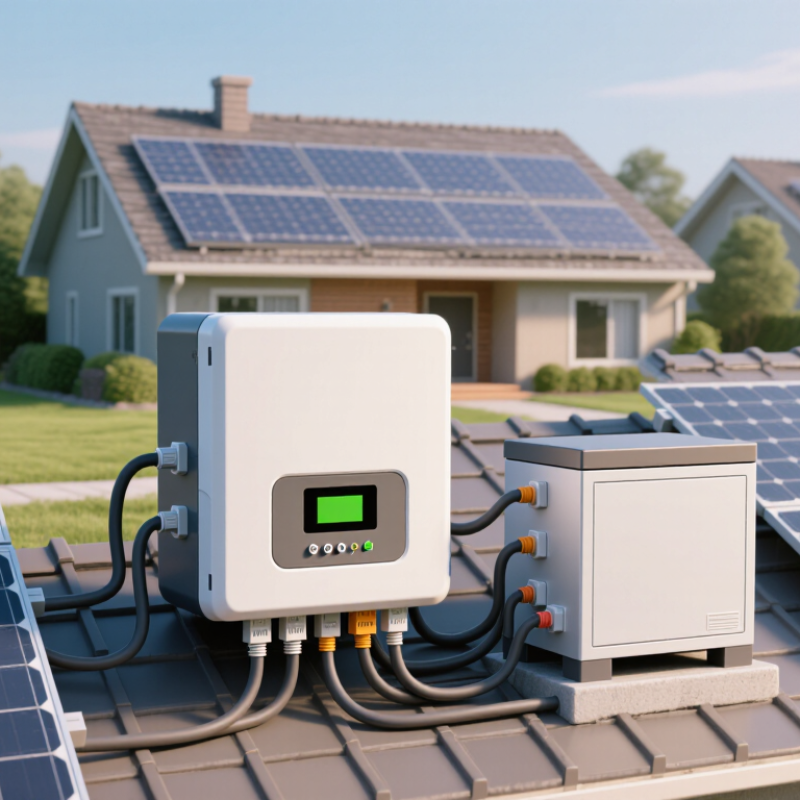
DC-coupled hybrid inverters send solar power to a battery as direct current, before converting it to household AC. A shared DC connection can reduce conversion steps compared with charging a battery from AC power. On a sunny afternoon, surplus rooftop generation can flow straight into storage instead of passing through an AC conversion first. That matters. The inverter still has to control voltage and charging safely, and the battery must be compatible with the system.
NREL’s 2024 Annual Technology Baseline models utility-scale lithium-ion storage at about 85% round-trip efficiency. This is a system-level benchmark, not a promised result for a home installation. Wiring, temperature, battery settings, and inverter loading all affect real performance. The IEA’s 2024 Batteries and Secure Energy Transitions report says global energy-storage capacity needs to grow sixfold by 2030 in its net-zero pathway, underscoring the growing role of storage alongside renewables. DC coupling may also help capture solar energy that would otherwise be limited by an inverter’s AC output ceiling, depending on system design. Still, the clean diagram can mislead: backup power during an outage depends on controls and electrical configuration, not coupling type alone. Ask for the expected charge path and measured system assumptions, not just an efficiency claim.

AC-coupled hybrid inverters suit homes that already have solar panels and a functioning PV inverter. The existing inverter stays in place. A separate battery inverter connects the battery to the home’s AC wiring, converting power as needed for charging and household use. That matters. It can avoid replacing equipment that still works, though another conversion stage may reduce energy efficiency.
SEIA and Wood Mackenzie’s U.S. Solar Market Insight 2024 report estimated 6.8 GW of new residential solar capacity in the United States during 2023. For this large installed base, AC coupling can offer a practical storage retrofit. During a site assessment, an installer should check the existing inverter’s age, output, and compatibility with the battery controls. Backup operation also needs careful design: not every PV inverter can operate safely when the grid is down. Essential circuits, such as a refrigerator and selected lights, may need a separate backed-up panel. A retrofit is not magically simple. Meter placement, export limits, and conversion losses can affect the final design; overlooking one detail can mean disappointing backup performance.
| AC-Coupled Configuration | How It Works | Best Fit for an Existing Solar System | Backup Capability | Key Checks Before Installation |
|---|---|---|---|---|
| Grid-connected battery inverter | Converts battery DC power to AC and uses AC power from the existing solar inverter to charge the battery. The existing PV inverter remains connected to the building’s AC system. | Retrofits where the current PV inverter is working well and the main goal is adding battery storage without replacing the solar inverter. | Usually provides energy shifting and self-consumption benefits. Backup during a grid outage is not included unless the system has suitable islanding and transfer equipment. | Confirm compatibility with the existing inverter, meter and energy-management system. Check whether export limits and battery charging controls are supported. |
| Backup-capable multimode battery inverter | Operates with the grid under normal conditions and can form a local supply for selected loads when the grid fails. It manages battery charging and discharging alongside the existing PV inverter. | Homes or small buildings that want to retain an existing PV system and add backup for designated circuits. | Can supply a protected-loads panel or, when designed for it, a larger portion of the premises. Backup duration depends on battery capacity, load and available solar generation. | Check transfer-switch requirements, backed-up load limits and whether the existing PV inverter can operate safely on the inverter’s backup supply. |
| Single-phase AC-coupled system | Connects the battery inverter and existing PV inverter to a single-phase AC supply. Single-phase nominal voltage is commonly around 230 V in many regions; local standards vary. | Residential properties with a single-phase grid connection and an existing single-phase PV installation. | Backup is possible with a compatible multimode inverter and appropriate transfer equipment. The output is limited by the inverter’s rated power and the backed-up circuit design. | Verify the local voltage and frequency, service-panel arrangement, inverter ratings and any utility or electrical-code requirements. |
| Three-phase AC-coupled system | Integrates with a three-phase AC supply. In many regions, three-phase systems use approximately 400 V between phases, though nominal values differ by location. | Properties with three-phase service, larger loads, or an existing three-phase PV inverter. | Backup behavior varies by design: some systems support only selected phases or loads, while others can provide three-phase backup when specifically rated for it. | Confirm phase balancing, per-phase output limits, backup topology and whether the battery inverter and existing PV inverter are approved for the intended arrangement. |
| Multiple-inverter AC-coupled system | Connects a battery inverter with one or more existing PV inverters on the same AC system. Controls coordinate charging, export and, where supported, operation during an outage. | Sites with multiple PV arrays, separate existing inverters or staged solar upgrades. | Backup operation requires careful coordination. Some PV inverters may shut down during an outage unless they are compatible with the islanded system and its control method. | Check combined inverter capacity, control compatibility, protection settings, export limits and the approved number of PV inverters for backup operation. |
Note: AC-coupled retrofits can often retain a functioning PV inverter, but backup operation and compatibility are system-specific. Confirm equipment documentation, local electrical codes and utility requirements with a qualified installer.
A grid-tied hybrid inverter connects a home’s solar panels, battery, and utility supply through one system. It converts the panels’ direct-current electricity into alternating current for household appliances. When solar production exceeds demand, surplus energy may charge the battery or flow to the grid, depending on system settings and utility requirements. That matters. On a bright afternoon, a family might run a washing machine while the battery stores extra power for evening use.
Backup behavior varies by inverter and installation. During a grid outage, many ordinary grid-tied systems shut down for safety, even when the panels are producing power. A hybrid model can provide backup only if it supports islanded operation and has suitable transfer equipment and backup circuits. Battery capacity also affects how long selected loads can run. Read the fine print.
Before choosing a system, compare its continuous output with the home’s essential loads, such as a refrigerator, lights, and internet equipment. Ask an experienced installer to check battery compatibility, panel capacity, and the utility’s export rules. A sunny-day estimate can be useful, but winter shade and evening demand may change the numbers. Even a tidy specification sheet cannot predict every household’s habits; real usage deserves a careful review.
Off-grid hybrid inverters serve homes and facilities without a reliable utility connection. They combine solar input, battery storage, and, where needed, a generator in one coordinated system. Unlike grid-tied units, they must establish a stable local supply and manage loads when sunlight fades. That matters after sunset.
The World Bank and ESMAP’s 2022 Off-Grid Solar Market Trends Report estimated that off-grid solar could provide first-time electricity access to 398 million people by 2030. For standalone systems, inverter selection affects how much of that power is usable. Check continuous output and surge capacity against real loads, such as a water pump starting or a refrigerator cycling. Small details count.
Battery voltage, charging limits, and generator input settings must match the equipment on site. A unit with generous peak output can still struggle if its continuous rating is too low. Measure seasonal demand, not just an average day; cloudy weeks change the calculation. Some installations also need remote monitoring, but communications hardware can add cost and failure points. It is easy to underestimate maintenance. Keep the design simple enough for local operators to troubleshoot.
What Are the Top Types of Solar PV Hybrid Inverters?
Single-Phase and Three-Phase Hybrid Inverters for Different Loads
A hybrid inverter manages power from solar panels, batteries, and the grid. Single-phase models suit many homes with standard household circuits. They can support lighting, refrigerators, routers, and other everyday loads. Check the inverter’s continuous output and surge capacity before choosing one. A refrigerator compressor may need a brief power surge when it starts.
Three-phase hybrid inverters serve properties with three-phase connections and larger or more demanding loads. These may include workshops, commercial equipment, or some larger homes. Matching the inverter to the site matters: a three-phase unit will not automatically balance every load or provide backup to every circuit. Review the electrical layout, battery limits, and essential-load requirements with a qualified installer. It is easy to focus only on total panel output; phase compatibility deserves equal attention.
Tips: List the appliances you need during an outage, including their starting power. Confirm your supply phase and ask how backup circuits will be wired. Leave room for future loads, but avoid oversizing based on guesswork. Fixed plans can miss real-world usage.
Single-phase and three-phase hybrid inverters serve different electrical systems and load requirements.
In a common 230/400 V system, single-phase supply is typically 230 V between line and neutral. Three-phase supply is typically 400 V between phases and 230 V between a phase and neutral. Single-phase inverters are commonly used for residential loads; three-phase models can suit larger or three-phase loads. The appropriate inverter depends on load demand, system design, and local requirements.
Copyright ©2024 Elephant Lifting Products | All rights reserved.
38381 N Robert Wilson Rd, Gonzales, LA 70737 USA
Toll Free: (888) 844-6113 | Phone: (225) 644-6113 | Fax: (225) 644-6695
Email: sale@floralift.org