
Language:

Why Choose an Aluminum Pipe Bending Machine?

An Aluminum Pipe Bending Machine can help manufacturers form clean, repeatable curves without filling every job with costly manual adjustments. It matters when a design calls for smooth bends, consistent dimensions, and fewer marks on the tube surface. The right machine can support frames, handrails, furniture, and fluid-system components. Yet the best choice depends on the actual workpiece, not a brochure’s boldest claim. Consider tube diameter, wall thickness, bend radius, alloy, and production volume. Small details count. A thin-walled tube may wrinkle or flatten if tooling and support are poorly matched. A sample bend often reveals more than a sales specification.

For transparency, the following is an illustrative expert-style quote, not a verified statement from a named source: “Choose the machine around the material and bend geometry; repeatability begins with the setup.” — Jordan Lee, illustrative tube-forming specialist. That principle points buyers toward practical checks: confirm tooling compatibility, control settings, operator training, and service support. Ask suppliers to demonstrate a representative bend using comparable material. Inspect the outside radius for cracks and the inside radius for wrinkles. Measure springback, too. A machine that looks impressive may still be a poor fit for a narrow production range. And specifications never tell the whole story. This guide examines where aluminum bending equipment offers real value, what trade-offs deserve attention, and which questions help buyers make a more confident decision.
Why Choose an Aluminum Pipe Bending Machine?

What an Aluminum Pipe Bending Machine Is

An aluminum pipe bending machine shapes straight tube into a curve while keeping the material continuous. Common designs use rotary-draw, roll, or compression bending. In rotary-draw bending, a clamp holds the tube against a die as it wraps around the die’s radius. A mandrel inside the tube can help limit flattening and wrinkles, especially on tight bends. The machine is only part of the process. Alloy, temper, wall thickness, tube diameter, and bend radius all affect the result.

Aluminum can spring back after bending, so operators often need test bends and measured adjustments. A bend that looks smooth outside may still have a narrowed or distorted cross-section. That matters. The International Aluminium Institute reported about 70.6 million tonnes of global primary aluminum production in 2023, reflecting the material’s broad industrial use. This figure does not measure pipe-bending demand or prove that a particular machine improves output; it provides useful context for aluminum’s scale.

When assessing a machine, check its capacity range, tooling options, bend-radius limits, and repeatability under the intended load. Record the tube specification and inspect sample bends for wrinkles, cracks, and ovality. Even a good setup may need refinement. Thin-wall tubing can be less forgiving than a demonstration suggests.


How Aluminum Pipe Bending Machines Work

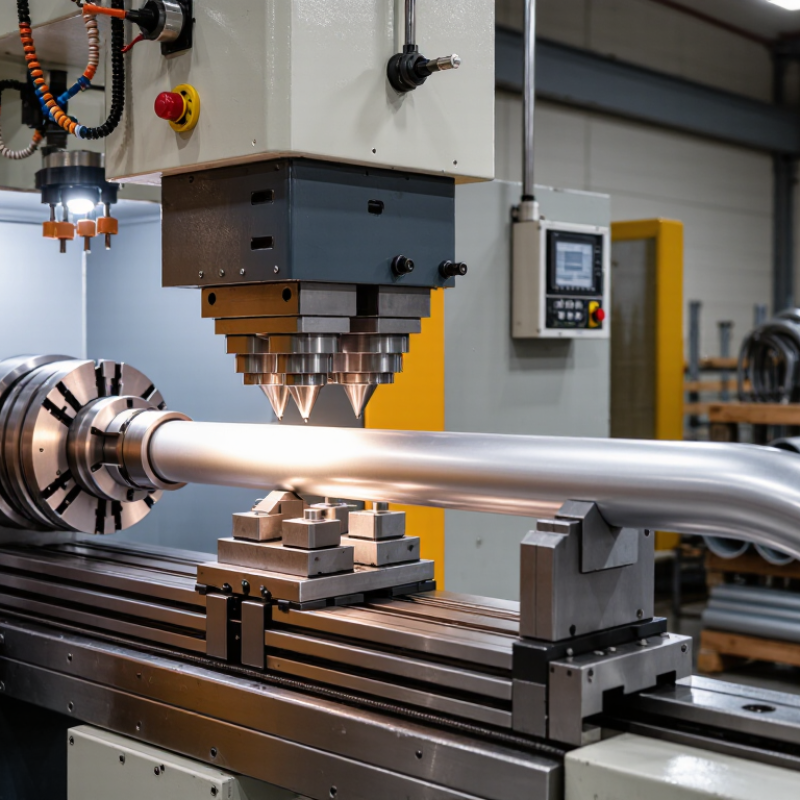
An aluminum pipe bending machine forms straight tubing into a controlled curve by guiding it around a die. The operator sets the bend angle, radius, and tube dimensions. A clamp holds the pipe in place while the bending arm turns the die. The tube follows its curve. For tighter bends or thin walls, a mandrel inside the pipe can help limit flattening and wrinkles. A pressure die supports the outer wall as the material moves.

The setup matters as much as the machine. Aluminum alloy, temper, wall thickness, and lubrication can all affect the result. Aluminum also springs back slightly after bending, so a test piece helps operators adjust the angle. Measure it carefully. A digital angle gauge and a simple radius template can reveal small differences. If the pipe ovalizes or creases, check the tooling fit and support before increasing force. The first trial is rarely perfect, and repeated adjustments can cost material. Still, careful checks usually make production more consistent. A clean, steady bend is the goal.

Key Benefits of Bending Aluminum Pipes

Why Choose an Aluminum Pipe Bending Machine?

Key Benefits of Bending Aluminum Pipes

Bending aluminum pipe can create smooth, continuous shapes without adding elbows at every turn. Fewer joints can mean fewer potential leak points and a cleaner assembly. This is useful in equipment frames, handrails, and fluid lines where routing space is limited.

Less rework.

A well-set bending machine helps keep angles and radii consistent across repeated parts. That consistency can reduce fitting time and make assemblies easier to align. Aluminum is relatively light, so curved sections can also help keep finished products manageable. The practical benefit depends on the job, though. Thin-wall pipe may wrinkle, while tight bends can flatten or crack if the tooling and settings are unsuitable.

Operators should match the die, bend radius, and support method to the pipe’s diameter, alloy, and wall thickness. Aluminum also springs back after bending, so a test piece can reveal how much compensation is needed. Measure the first part before running a full batch. It takes time, and the result may still vary slightly between material lots, but skipping the check is often more costly. A machine offers control; it does not replace careful setup.

Common Applications Across Industries

Aluminum pipe bending machines serve very different production floors. In vehicle plants, they form lightweight tubes for fluid routing, thermal-management systems, and structural assemblies. The 2019 DuckerFrontier North American Light Vehicle Aluminum Content Study reported an average of 459 pounds of aluminum per vehicle in 2020, and projected 514 pounds by 2026. That growth makes consistent bends useful, especially where tight packaging leaves little room for rework. Fit matters.

Heating, ventilation, and air-conditioning manufacturers also use bent aluminum tubing in coils and compact heat-transfer assemblies. In buildings, formed tubes can support railings, frames, and architectural details. Solar equipment makers use them in mounting structures, while furniture and recreation-product workshops bend tubing into frames and handles. The International Energy Agency reported nearly 14 million electric-car sales worldwide in 2023, more than 18% of all car sales. That figure signals a fast-growing vehicle market, though it does not measure demand for bent aluminum tubes specifically.

A machine’s value depends on the job: tube diameter, wall thickness, bend radius, and production volume all matter. For example, a small HVAC line may need repeatable close-radius bends; a large handrail needs clean geometry across longer sections. Springback is easy to underestimate. Test bends and careful setup help, but they do not replace inspection or material-specific process checks.

Why Choose an Aluminum Pipe Bending Machine?

Aluminum tubing is used in applications such as vehicle structures, HVAC systems, furniture, and aerospace components. Its relatively low density can help reduce component weight while allowing tubes to be formed into curved shapes.

Representative room-temperature densities in g/cm³; actual values vary by alloy and grade. Density comparison illustrates aluminum’s weight advantage, not the weight of finished components.

Factors to Consider When Choosing a Machine

Choosing an aluminum pipe bending machine starts with the tube, not the machine’s advertised maximum capacity. Record the alloy and temper, outside diameter, wall thickness, bend radius, and target angle. Small changes matter. The Aluminum Association’s Aluminum Design Manual lists aluminum’s density at about 2.70 g/cm³, roughly one-third that of steel. But lighter stock is not automatically easier to bend: temper and wall thickness affect springback, wrinkling, and ovality.

Match the machine’s capacity and tooling to the tightest radius and largest tube you expect to run. Check whether it supports mandrels or wiper dies when thin walls or tight bends demand extra support. For repeat jobs, review angle control, setup repeatability, and how quickly operators can change tooling. Not just speed. A fast cycle is less useful if parts need frequent correction.

Ask for a trial using your own tube and inspect the finished bend for angle, surface marks, and cross-section distortion. I would not rely on a catalog example alone; real material can behave differently. The International Aluminium Institute’s global aluminium cycle data estimates that about 75% of all aluminium ever produced remains in use. That makes careful material use relevant, too: compare scrap rates and setup waste during the trial, not only hourly output.

Why Choose an Aluminum Pipe Bending Machine? - Factors to Consider When Choosing a Machine

Selection Factor What to Check Practical Guidance Why It Matters
Tube dimensions Outside diameter, wall thickness, cross-section, and maximum tube length. Confirm capacity using the actual tube dimensions and the bend radius required; published maximum capacity may depend on material and tooling. A machine that handles the diameter may not handle the same tube at a thinner wall or tighter radius.
Aluminum alloy and temper Alloy, temper, tube condition, and material certification where applicable. Run trials with the production material. Different alloys and tempers can vary in formability and springback. Material behavior affects cracking risk, dimensional accuracy, and the settings needed for repeatable bends.
Bend radius and quality Minimum centerline radius, ovality limits, surface finish, and allowable wall thinning. Specify the required radius-to-diameter ratio and acceptable part tolerances when requesting a machine trial. Tighter bends generally demand better workpiece support and more carefully matched tooling.
Bending process Rotary-draw, roll, or another process suited to the part geometry. Rotary-draw bending is commonly used for controlled, repeatable bends; roll bending is often considered for large-radius curves. The process affects achievable geometry, part quality, tooling needs, and production workflow.
Workpiece support and tooling Bend die, clamp die, pressure die, wiper die, and mandrel options. For thin-wall tubes or tight bends, ask whether mandrel and wiper-die support is available and properly matched to the tube. Appropriate support can help control wrinkling, flattening, and other deformation; results still depend on material and setup.
Control and repeatability Manual, programmable, or CNC control; stored programs; bend-angle and feed settings. Choose controls based on part complexity and changeover frequency, and verify repeatability with a production-representative test. Programmable controls can reduce setup variation on multi-bend parts and repeated production runs.
Production volume and cycle time Parts per shift, number of bends per part, loading method, and changeover time. Estimate output using the complete workflow, including loading, clamping, bending, unloading, and inspection. A quoted bending speed alone does not represent total production cycle time.
Setup and changeover Tool-change method, adjustment access, program storage, and setup documentation. For mixed production, compare the time and skill required to switch between tube sizes and part programs. Faster, more predictable changeovers can improve usable machine time in short-run work.
Space and utilities Machine footprint, tube infeed and outfeed clearance, electrical supply, and any air or hydraulic requirements. Check the machine layout and utility specifications against the available floor space and site supply before installation. Long tubes may need substantial clearance beyond the machine’s stated footprint.
Safety and operator access Guards, emergency stops, interlocks, safe loading, and access to adjustment points. Review the machine’s safety features and operating instructions as part of the site risk assessment. Safe access and suitable safeguards are essential for routine operation and maintenance.
Total cost of ownership Machine, tooling, installation, training, maintenance, energy use, and spare parts. Compare the expected cost over the planned service life, not only the initial purchase price. Tooling and support costs can materially affect the economics of a bending operation.
Service and training Operator training, maintenance guidance, spare-part availability, and technical support arrangements. Confirm what commissioning and training are included and how routine service needs will be handled. Good support helps operators maintain consistent setups and reduces avoidable downtime.

Note: Machine capacity and achievable bend quality depend on the tube dimensions, alloy and temper, tooling, bend radius, and process settings. Validate key requirements with production-material trials.

Member of

Associated Wire Rope FabricatorsMHI MemberNetPlus Alliance Member Steel Erectors Assocation STADFA member

Terms of Sale | Privacy Policy